Friday, August 5, 2011

AS SEEN ON TV: JIM BOWIE

JIM BOWIE

AS SEEN IN:
'The Improbable History Of Mr. Peabody'

AS PLAYED BY:
Paul Frees

From Wikipedia:
On September 19, 1827, Jim Bowie and Sheriff Norris Wright attended a duel on a sandbar outside of Natchez, Mississippi. Bowie supported duellist Samuel Levi Wells III, while Wright supported Wells's opponent, Dr. Thomas Harris Maddox. The duellists each fired two shots and, as neither man had been injured, resolved their duel with a handshake. Other members of the groups, who had various reasons for disliking each other, began fighting.

Bowie was shot in the hip; after regaining his feet he drew a knife, described as a butcher knife, and charged his attacker, who hit Bowie over the head with his empty pistol, breaking the pistol and knocking Bowie to the ground. Wright shot at and missed the prone Bowie, who returned fire and possibly hit Wright. Wright then drew his sword cane and impaled Bowie.

When Wright attempted to retrieve his blade by placing his foot on Bowie's chest and tugging, Bowie pulled him down and disemboweled Wright with his large knife. Wright died instantly, and Bowie, with Wright's sword still protruding from his chest, was shot again and stabbed by another member of the group. The doctors who had been present for the duel retrieved the bullets and patched Bowie's other wounds.

Many historians and even members of Bowie's own family believe that it was Rezin Bowie who actually invented the knife, but it was the "Sandbar Fight" that brought it fame.

However, in the Tooniverse, it was Mr. Peabody who invented the knife in 1825 so that Jim Bowie would have the proper utensil to cut the steaks at his Mississippi restaurant, "Bowie's Beanery".

BCnU!

Thursday, August 4, 2011

"THE RIFLEMAN" - S#!T CARSON

'THE RIFLEMAN'

"End Of A Young Gun"

When Will Fulton was recovering from a broken leg at the McCain ranch, he told Lucas how his parents had been killed when a man named Carson stole their farm.

If it's the man I'm thinking of, I don't think this Carson would have done the job himself. He probably had men working for him to do his dirty work. Everybody would know that they were Carson's hired thugs, but there would never be any proof to that fact. It would have been these outlaws who committed the murderous land grab, but it would have been on Carson's orders.

And who was this man named Carson?

I think he was the former Senator from Nevada, perhaps related (at least in Toobworld) to Kit Carson after whom Carson City, Nevada, was named. He was seen in the 'Bonanza' episode "The Iron Butterfly".
 Carson was a bitter, brutal man by the time he ordered his men to kill the Fultons, having lost his son in 1871 during an altercation with Hoss Cartwright over an actress. Carson served as one of the state's senators at some point between 1864 (when the state was founded) to some time after the events of "The Iron Butterfly" took place. (Although it could be he was already retired from Congress by 1871; Ben Cartwright would still have addressed him as "Senator" as a formal courtesy.)

By 1881, when Will Fulton arrived at the McCain ranch, Senator Carson was apparently  focusing his energies on building his personal wealth and his own private empire - by stealing the land of his neighbors.
BCnU!

LANDON ROLES ON "THE RIFLEMAN"

'THE RIFLEMAN'
"End Of A Young Gun"
When Mark gets caught on a mountain ledge, a young outlaw risks his life to rescue him and breaks his leg doing so.

"The Mind Reader"
A young man accused of a murder he didn’t commit is finally cleared by the accidental discovery of a “mind reader.”

We met two of Little Joe Cartwright's children in the 'Bonanza' TV movie sequels - Benj and Sara. But he may have had at least one other son many years earlier, when he was practically still a boy himself.
"Hello, Darlin'...."
At some point in 1861, when he was 19 years old, Little Joe could have had an affair with a married homesteader named Mrs. Fulton. (She may even have been his first.) Mrs. Fulton already had a son Henry (known by the nickname "Hank") by her husband; but for whatever reason, she felt the need to stray outside her marriage. And from that affair (which was more than likely just a one-night stand), she became pregnant by Little Joe but passed the child off as her husband's. (The virility of TV characters being akin to that of the Greek gods, a child would naturally have resulted from the one-night stand.)
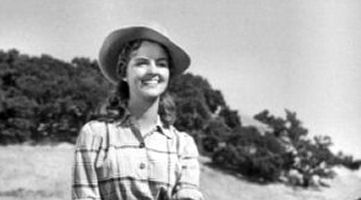
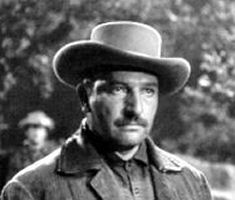
Little Joe Cartwright (left) and Will Fulton (right)
As he got older, it would eventually become evident by his physical features that William "Will" Fulton was the son of Little Joe Cartwright. But the buffalo chips never hit the fan with any revelation of the scandal, however. When Will was still young, probably no more than fifteen, he and his half-brother Hank were left orphans after their parents were killed by a man named Carson who stole their land.
The Fulton boys turned to crime in their grief, but Will's heart was never into it. The outlaw life may have eventually led to his death, had his path never crossed with Mark McCain and his father Lucas (who was also known as 'The Rifleman'.)
(Both Lucas and Mark McCain kept journals of their life in Northfork, New Mexico, which are available on line where you can read Lucas' account of their encounter with Will Fulton.)

That episode of 'The Rifleman', "End Of A Young Gun", took place from August through September of 1881, not long after the McCains bought the Dunlap ranch. So if Will Fulton was nineteen years old as the Marshal figured, then he was born in 1862. And if he was the son of Little Joe Cartwright, he was probably conceived in 1861, when Little Joe was only nineteen himself. (Little Joe was born in 1842.)

I've looked through the 'Bonanza' episode guide to see if there was any place in which an off-screen "adventure" could have taken place in which Little Joe was able to conceive a son by Mrs. Fulton. The easiest answer would be during the show's hiatus between the second and third season, at some point between "Sam Hill" [June 3, 1961] and "The Smiler" [September 24, 1961.]

Why 1961? A prominent 'Bonanza' fan-site says that the common thinking in establishing the dateline for the show is that each season was broadcast 100 years after the "actual" events took place. So if we're looking for something that happened in 1861, it had to be found in (or between) the episodes shown in 1961. I tend to agree with that thinking.

But I did find an actual episode which definitely had pozz'bilities to be the framework in which Little Joe met and impregnated Mrs. Fulton......

From "Bonanza: Scenery Of The Ponderosa":
59.) The Gift
April 1, 1961
While crossing the desert to Yuma, Arizona, with a white stallion intended as a birthday present for Ben, Joe runs into a pack of merciless comancheros. His companion, a former comanchero, Emiliano, who raised the horse, must get he and Joe through safely. A season two highlight of the series.
While he was on the way to Yuma to make the purchase of the horse, Little Joe may have spent the night with Mr. and Mrs. Fulton and their son Hank.

(In my imagination, I see the situation develop along the same lines as seen in the movie "The Missouri Breaks" when John P. Ryan's character of Cy was going to sleep in the barn of another homesteader family, and the wife showed him out to the barn......)
Since Will Fulton voluntarily turned himself in and returned the loot stolen by Hank and his gang, he may have been given a much-reduced sentence by Judge Hanavan (perhaps influenced by Lucas McCain's testimony.) I don't think he would have been sent away to prison for any longer a time than six months. After he paid his debt to society, Fulton returned to North Fork, but he had changed his name to William "Billy" Mathis because he wanted a fresh start in life.
(I'm not sure if the shocking conditions we see in today's prisons - as depicted in a show like 'Oz' - existed back then, but a pretty boy like Will......? It must have been uncomfortable in the saddle on the ride back to North Fork.......)
Unfortunately for Will, it looks as though the lovely young Ann Bard who met him while he was recuperating at the McCain ranch couldn't wait for him to serve out his sentence. By the time we meet up with him again - as I said, now with the moniker of Billy Mathis - he was seeing the daughter of another rancher, Lucy Hallager.
Billy ended up being framed for the murder of Lucy's father, who told Billy publicly to stay away from his daughter. (Probably because of Billy's time spent in prison and riding with Hank Fulton's gang.) Things were going so badly for Billy during the trial that Lucy broke him out of the jail. (Because of incidents like this, Marshal Micah Torrance now has a bad reputation among many televisiologists. But if he was better at his job, there wouldn't have been that much for "the Rifleman" to do.)
Luckily, North Fork was visited by a traveling "mind reader" named John Barrow McBride whose "powers" were used to flush out the real killer. Billy and Lucy were then free to start new lives; and since they were never seen again in North Fork, it's pozz'ble, just pozz'ble, that Lucy sold the family ranch to finance their future together.
I was tempted to say that Billy pursued a career in the cavalry - as seen with an unnamed Michael Landon character in an episode of 'Cheyenne', but the Toobworld timeline prohibits that. "Decision" took place back in the 1870's, as did the 'Cheyenne' series in general.

On second thought, that's probably a good thing, considering.....
One last thing:

One thing I always enjoy about the Toobworld timeline is how sometimes events are broadcast out of order. We got to meet Michael Landon's character(s) of Will Fulton/Billy Mathis a few years before he finally hit the big time with his signature role of Little Joe Cartwright on 'Bonanza'......
BCnU!

THE HAT SQUAD: BUBBA SMITH

From the New York Times:

Bubba Smith, an outsize presence in the National Football League who went on to a prolific career in television and the movies, was found dead on Wednesday at his home in Los Angeles. He was 66.

The cause was not yet known, a spokesman for the Los Angeles County coroner’s office said, adding, “There is no indication of anything other than natural death."

As an actor, Bubba Smith is best known as Hightower in the "Police Academy" movies, a role he crossed over into the TV Universe for an episode of the televersion of the film franchise.

Smith added several citizens to the Tele-Folks Directory of Toobworld, especially regular roles in such series as 'Half Nelson', 'Semi-Tough', 'Good Times', 'Open All Night' and 'Blue Thunder'. But as a member of the League of Themselves, Bubba Smith certainly qualifies for the TV Crossover Hall Of Fame:

1994
'Married with Children' - "Dud Bowl"

1992
'Coach' - "The Bachelor Party"

1991
'Who's the Boss?' - "Death and Love: Part 2"

1987
'Mr. Belvedere' - "Separation"

1986
'Mary' - "And the Winner Is"

1973
'The Odd Couple' - "Take My Furniture, Please"

And then there were his serlinguistic turns in those Miller Lite commercials....


Good night, and may God bless.

BCnU........

AS SEEN ON TV: FRANK DALTON

FRANK DALTON


AS SEEN IN:
"The Last Ride Of The Dalton Gang"

AS PLAYED BY:
Don Collier

From Wikipedia:
Frank Dalton (June 8, 1859 – November 27, 1887) was a Deputy US Marshal of the Old West under Judge Isaac Parker, for Oklahoma Territory, as well as the older brother to the members of the Dalton Gang, in addition to being the brother to William M. Dalton, once a member of California legislature, and later an outlaw and leader of the Doolin Dalton gang alongside Bill Doolin. Frank Dalton is not to be confused with J. Frank Dalton, who made many claims to be famous people, including his claim of being Frank Dalton, and later Jesse James.

Dalton became, without much effort, the success story of the Dalton family. He was commissioned as a Deputy US Marshal, serving under Judge Parker, and quickly developed a reputation as being a brave lawman. Based out of Fort Smith, Arkansas, Dalton was involved in a number of shootouts and high risk arrests over a three year period. However, on November 27, 1887, he and Deputy J.R. Cole were on the trail of outlaw Dave Smith, wanted for horse theft. As they approached Smith's camp, Smith fired a shot from a rifle, hitting Dalton in the chest. Deputy Cole returned fire, killing Smith, but was then shot and wounded by a Smith cohort.

Cole was able to make his escape, however, believing Dalton was dead. Dalton, however, was still alive, and engaged the outlaws in a short gunbattle. One of Smith's cohorts was wounded, and a woman who was in the camp was killed during the crossfire. Frank Dalton was dead by the time Deputy Cole returned with a posse, having been killed with two additional rifle shots by outlaw Will Towerly. The outlaw wounded by Dalton never revealed his own name. He died shortly thereafter, but not before naming Towerly as Frank Dalton's murderer.

A newspaper of the time indicated Dalton had begged Towerly not to kill him, saying he was already dying. However that was a rumour, and there were no witnesses to the crime who ever made that statement. Towerly was killed one month later by Deputy William Moody and Deputy US Marshal Ed Stokley. Stokley was also killed during the gunfight.

BCnU!

Wednesday, August 3, 2011

"THE RIFLEMAN" - ON THE RICHTER SCALE

'THE RIFLEMAN'
"TRAIL OF HATE"
Ben Stark's brother was Noley Stark, who was seriously gut-shot by Lucas McCain when he tracked down the men who injured his son Mark. But Noley probably survived his gunshot wound and had a family once he got out of prison. One of his descendants could have been Brad White, a doomed operative of the spy organization known as "The Ring" (as seen in 'Chuck'.)
BCnU!

AS SEEN ON TV: PRESIDENT ANDREW JACKSON

It's unfortunate that it took the death of great character actor G.D. Spradlin to bring two of his historical roles to attention for use in the ASOTV gallery during our salute to the TV Western.

Here's one of them......

PRESIDENT ANDREW JACKSON

AS SEEN IN:
'Houston: The Legend Of Texas'

AS PLAYED BY:
G.D. Spradlin

From Wikipedia:
In 1822 Sam Houston was elected to the US House of Representatives for Tennessee, where he was a staunch supporter of fellow Tennessean and Democrat Andrew Jackson. He was widely considered to be Jackson's political protégé, although their ideas about appropriate treatment of Native Americans differed greatly.

Perhaps the most controversial aspect of Jackson's presidency was his policy regarding American Indians, which involved the ethnic cleansing of several Indian tribes. Jackson was a leading advocate of a policy known as Indian removal. Jackson had been negotiating treaties and removal policies with Indian leaders for years before his election as president. Many tribes and portions of tribes had been removed to Arkansas Territory and further west of the Mississippi River without the suffering of what later became known as the Trail of Tears. Further, many white Americans advocated total extermination of the "savages", particularly those who had experienced frontier wars. Jackson's support of removal policies can be best understood by examination of those prior cases he had personally negotiated, rather than those in post-presidential years. Nevertheless, Jackson is often held responsible for all that took place in the 1830s.

In his December 8, 1829, First Annual Message to Congress, Jackson stated:
This emigration should be voluntary, for it would be as cruel as unjust to compel the aborigines to abandon the graves of their fathers and seek a home in a distant land. But they should be distinctly informed that if they remain within the limits of the States they must be subject to their laws. In return for their obedience as individuals they will without doubt be protected in the enjoyment of those possessions which they have improved by their industry.

Before his election as president, Jackson had been involved with the issue of Indian removal for over ten years. The removal of the Native Americans to the west of the Mississippi River had been a major part of his political agenda in both the 1824 and 1828 presidential elections. After his election he signed the Indian Removal Act into law in 1830. The Act authorized the President to negotiate treaties to buy tribal lands in the east in exchange for lands further west, outside of existing U.S. state borders.

While frequently frowned upon in the North, the Removal Act was popular in the South, where population growth and the discovery of gold on Cherokee land had increased pressure on tribal lands. The state of Georgia became involved in a contentious jurisdictional dispute with the Cherokees, culminating in the 1832 U.S. Supreme Court decision (Worcester v. Georgia), which ruled that Georgia could not impose its laws upon Cherokee tribal lands. Jackson is often quoted (regarding the decision) as having said, "John Marshall has made his decision, now let him enforce it!" Whether he said it is disputed.

In any case, Jackson used the Georgia crisis to pressure Cherokee leaders to sign a removal treaty. A small faction of Cherokees led by John Ridge negotiated the Treaty of New Echota with Jackson's representatives. Ridge was not a recognized leader of the Cherokee Nation, and this document was rejected by most Cherokees as illegitimate. Over 15,000 Cherokees signed a petition in protest of the proposed removal; the list was ignored by the Supreme Court and the U.S. legislature, in part due to delays and timing. The treaty was enforced by Jackson's successor, Van Buren, who ordered 7,000 armed troops to remove the Cherokees. Due to the infighting between political factions, many Cherokees thought their appeals were still being considered until troops arrived. This abrupt and forced removal resulted in the deaths of over 4,000 Cherokees on the "Trail of Tears".

By the 1830s, under constant pressure from settlers, each of the five southern tribes had ceded most of its lands, but sizable self-government groups lived in Georgia, Alabama, Mississippi, and Florida. All of these (except the Seminoles) had moved far in the coexistence with whites, and they resisted suggestions that they should voluntarily remove themselves. Their nonviolent methods earned them the title the Five Civilized Tribes.

More than 45,000 American Indians were relocated to the West during Jackson's administration. A few Cherokees escaped forced relocation, or walked back afterwards, escaping to the high Smoky Mountains along the North Carolina and Tennessee border. Jackson's administration bought about 100 million acres (400,000 km²) of Indian land for about $68 million and 32 million acres (130,000 km²) of western land. Jackson was criticized at the time for his role in these events, and the criticism has grown over the years. U.S. historian Robert Vincent Remini characterizes the Indian Removal era as "one of the unhappiest chapters in American history."

Houston went west and lived again among the Cherokee in the Arkansas Territory, who in October 1829 formally adopted him as a citizen of their nation. Houston's abandonment of his gubernatorial office and his wife all caused a rift with his mentor President Jackson. They were not reconciled for several years.

Houston left for Texas in December 1832 and was immediately swept up in the politics of what was still a territory of the Mexican state of Coahuila-Texas. Historians have speculated that Houston went to Texas at the request of President Jackson to seek U.S. annexation.

BCnU!

"THE RIFLEMAN" - FAKER OATS

'THE RIFLEMAN'
"Home Ranch"
After two of Oat Jackford’s cowhands burn the McCain’s house, drag Lucas, and steal his rifle, Lucas goes to hunt Jackford and his men to inform them that he and his boy are there to stay.

"The Money Gun"
Bookkeeper Asa Manning hires a professional gunman to provoke his client, a bully rancher who suspects him of embezzlement, into a gunfight.

"Trail Of Hate"
Lucas goes on a hunt for bank robbers after Mark is badly hurt while being held hostage.

From "The Rifleman Episode Guide List"

 When Lucas McCain's ranch-house was burned down by some of Oat Jackford's men, McCain went hunting for his neighboring rancher to settle the score.

The only thing was, the man he found wasn't the real Oat Jackford, even though his own cowhands believed him to be.
He was Ben Stark, a criminal passing himself off as Oat Jackford, who must have been out of North Fork on business. As for the ranch hands, Stark probably hired them, telling them that he was Oat Jackford. He then kept them out on the plains to avoid meeting anybody else in Jackford's employ or family and thereby learning the truth.

I can't say why Ben Stark was pulling this scheme, but he must have been planning to steal something large from Jackford. Maybe it was statuary, something akin to the MacCready Bust (as seen in 'Alias Smith And Jones'.) Perhaps he was going to intercept a shipment coming in on the stage, maybe it was the payroll for the real ranch hands. (And if so, he probably created a ruse to get the real Oat Jackford out of town.)
So Ben Stark needed those itinerant ranch hands to help him get it loaded onto a wagon.

The altercation with Lucas McCain would have been a kink in the plan, but he turned it to his advantage. The real Oat Jackford might have killed Lucas McCain for his insolence and for the beating Luke gave to him. But instead, the fake Oat Jackford sent those new hired hands over to build a new house for Lucas and his son. (They used building supplies bought in town and most likely charged to Oat Jackford's account.)

Nearly two years later, Ben Stark returned to North Fork with his brother and another cowhand in order to rob the bank. Lucas McCain didn't recognize him, or so it looked, but Stark must have chose Lucas as his patsy because he remembered the earlier incident.
How the real Oat Jackford reacted once he returned to North Fork was never made available for viewing by the Trueniverse audience, of course. But it must have contributed to the surly, belligerent attitude displayed by Jackford when he came into town to face down a hired gun. More than likely, he decided to keep quiet about the theft and the expenses incurred to re-build the McCain ranch house rather than be seen as a fool by the rest of the town......
The REAL Oat Jackford

BCnU!

Tuesday, August 2, 2011

"THE RIFLEMAN" - FAMILIAL FLASHBACK

Back in February, I wrote up a theory of relateeveety for a minor guest character in an episode of 'The Rifleman', which hopefully provided a link between our showcase series for the month and 'Burke's Law' and 'Petticoat Junction'.......

"THE THREE JOE CARSONS"

It's probably what got me started on the idea to feature 'The Rifleman' this month....

 BCnU!

AS SEEN ON TV: BILLY THE KID

Toobworld Central published two other ASOTV showcases for Billy the Kid in the past - a "Two For Tuesday" spotlight on his appearances in 'Stories Of The Century' and 'The Time Tunnel', and in the Tooniverse during a wild yarn told by Commander McBragg.

Both of those were not the true depictions of Billy the Kid in Earth Prime-Time. 'Stories Of The Century' featured fabrications told by former railroad detective Matt Clark for the penny dreadfuls. And the Billy the Kid who encountered the time travelers Doug and Tony was from a parallel dimension.

As mentioned in the previous post, I think the Billy the Kid played by Dennis Hopper in the 'Sugarfoot' pilot was Billy Turlock and not Henry McCarty AKA William Bonney.

And the Billy the Kid whom Bret 'Maverick' met was an escapee from the local asylum outside of Bubbly Springs.

 
 But I will accept one portrayal of Billy the Kid to be the official version for Earth Prime-Time......

BILLY THE KID

AS SEEN IN:
'The Tall Man'

AS PLAYED BY:
Clu Gulager

The show was about the uneasy relationship between Billy and "the tall man," Pat Garrett - which may have existed only in legend......

From Wikipedia:
During this time [November of 1880], McCarty became acquainted with an ambitious local bartender and former buffalo hunter named Pat Garrett. While popular accounts often depict McCarty and Garrett as "bosom buddies", there is no concrete evidence that they were ever friends. Running on a pledge to rid the area of rustlers, Garrett was elected as sheriff of Lincoln County in November 1880, and in early December, he assembled a posse and set out to arrest McCarty, at that time known almost exclusively as "Billy the Kid", and he carried a $500 bounty on his head that had been authorized by governor Lew Wallace.

The posse led by Garrett fared well, and his men closed in quickly. On December 19, McCarty barely escaped a midnight ambush in Fort Sumner, which left one member of the gang, Tom O'Folliard, dead. On December 23, the Kid was tracked to an abandoned stone building located in a remote location known as Stinking Springs (near present-day Taiban, New Mexico). While McCarty and his gang were asleep inside, Garrett's posse surrounded the building and waited for sunrise. The next morning, a cattle rustler named Charlie Bowdre stepped outside to feed his horse. Mistaken for McCarty, he was shot down by the posse. Soon afterward, somebody from within the building reached for the horse's halter rope, but Garrett shot and killed the horse, whose body blocked the building's only exit. As the lawmen began to cook breakfast over an open fire, Garrett and McCarty engaged in a friendly exchange, with Garrett inviting McCarty outside to eat, and McCarty inviting Garrett to "go to hell". Realizing that they had no hope of escape, the besieged and hungry outlaws finally surrendered later that day and were allowed to join in the meal.
Sheriff Pat Garrett offered that he responded to rumors that McCarty was lurking in the vicinity of Fort Sumner almost three months after his escape. Garrett and two deputies set out on July 14, 1881, to question one of the town's residents, a friend of McCarty's named Pete Maxwell (son of land baron Lucien Maxwell). Close to midnight, as Garrett and Maxwell sat talking in Maxwell's darkened bedroom, McCarty unexpectedly entered the room.

There are at least two versions of what happened next. One version suggests that as the Kid entered, he failed to recognize Garrett in the poor light. McCarty drew his pistol and backed away, asking "¿Quién es? ¿Quién es?" (Spanish for "Who is it? Who is it?"). Recognizing McCarty's voice, Garrett drew his own pistol and fired twice, the first bullet striking McCarty in the chest just above his heart, killing him. In a second version, McCarty entered carrying a knife, evidently headed to a kitchen area. He noticed someone in the darkness, and uttered the words, "¿Quién es? ¿Quién es?" at which point he was shot and killed in ambush style. Although the popularity of the first story persists, and portrays Garrett in a better light, some historians contend that the second version is probably the accurate one. A markedly different theory, in which Garrett and his posse set a trap for McCarty, has also been suggested. Most recently explored in the 2004 Discovery Channel documentary, "Billy the Kid: Unmasked", this theory contends that Garrett went to the bedroom of Pedro Maxwell's sister, Paulita, and bound and gagged her in her bed. When McCarty arrived, Garrett was waiting behind Paulita's bed and shot the Kid.

That part of the story never came up during the run of 'The Tall Man'......

It's a somewhat flexible rule of Toobworld Central that if an historical figure gets his or her own TV series, then that should be the official version for Earth Prime-Time. This would trump the "First Come, First Served" rule. So even though 'The Tall Man' strays far from the truth, that matters little in a universe where time travelers and robots roam the Wild West.

As for depictions of Billy in mini-series and TV movies, like similar portrayals of George Washington, Abraham Lincoln, John F. Kennedy, and Marilyn Monroe, they all get separate homes in alternate TV dimensions.

So Clu Gulager is the official Billy the Kid for Toobworld.
BCnU!