Saturday, May 4, 2019

TVXOHOF MEMORIAL TRIBUTE - PETER MAYHEW


May the Fourth be with you….


From The Los Angeles Times:
Peter Mayhew, who brought the Wookiee warrior Chewbacca to life in the original “Star Wars” trilogy, has died at age 74.

The British actor’s family announced his death on social media, saying that he had died Tuesday at his home in North Texas. No cause was given.

“He put his heart and soul into the role of Chewbacca and it showed in every frame of the films from his knock kneed running, firing his bowcaster from the hip, his bright blue eyes, down to each subtle movement of his head and mouth,” Mayhew’s family wrote in a statement. “But, to him, the Star Wars family meant so much more to him than a role in a film.”


Standing at 7 feet 3, Mayhew was originally cast as the fierce, furry sidekick and copilot to Harrison Ford’s Han Solo owing entirely to his imposing physicality. Desperate to find someone in England who would be taller than Darth Vader, played by 6-foot-6 bodybuilder David Prowse, George Lucas found Mayhew, who had been working as a hospital orderly when he was discovered a year earlier and cast in the role of the Minotaur in Ray Harryhausen’s fantasy film “Sinbad and the Eye of the Tiger.”


From The Guardian:

The actor Peter Mayhew, who has died of a heart attack aged 74, carved out a place for himself in movie history when he played Chewbacca, Han Solo’s furry sidekick, in the Star Wars films. The 200-year-old Wookiee warrior, smuggler and resistance fighter, known affectionately as “Chewie”, was Han’s co-pilot on the Millennium Falcon starship, fighting the Galactic Empire.

Lovable and loyal, with super-human strength and bravery, Chewbacca served as the conscience of Han, played by Harrison Ford, but Mayhew had no need to learn lines for the role because the Star Wars sound designer, Ben Burtt, voiced him with a mix of animal growls sourced from walruses, bears, tigers, camels and badgers. The 7ft 3in actor, his face concealed by a mask and wearing a mohair and yak hair costume, simply gave grunts and shrieks as cues to his fellow cast members. However, before filming, Mayhew had studied how gorillas moved, and he brought a distinctive knock-kneed gait to the role that endeared his character to audiences.


“Chewbacca is more of a teddy bear or security blanket,” he said in 2015. “He’s who you count on when things get scary. His size isn’t intimidating because he’s on your side. Chewie doesn’t waste time talking – he just comes in and saves the day.”


From the IMDb:

Born
May 19, 1944 in Barnes, London, England, UK
Died
April 30, 2019 in Boyd, Texas, USA  (heart attack)
Height
7' 3" (2.21 m)


Peter Mayhew was born on May 19, 1944 in Barnes, London, England.  Residing in Texas [before his death], this former resident of Yorkshire, England, was working as a hospital attendant at the King's College Hospital in London when film producer Charles H. Schneer saw his photo, literally standing above the crowd around him. Charles H. Schneer cast him in "Sinbad and the Eye of the Tiger" (1977), Ray Harryhausen's special effects film. It was just over a year later that he was asked if he wanted to do another role. Mayhew was told it was for a big hairy beast. It was the role of Chewbacca, the faithful 200 year-old Wookiee in "Star Wars: Episode IV - A New Hope" (1977) and his life was changed forever. Following the original "Star Wars" trilogy, Mayhew has done several commercials in the Wookiee costume including one for Cingular and Orange associated with "Star Wars: Episode III - Revenge of the Sith" (2005). In 1997, the twentieth anniversary celebrations of "Star Wars" were announced with the release of the "Special Edition" and all the conventions started. He [was] active on the "Star Wars" convention circuit where he signed autographs. He [wrote] two books, "Growing Up Giant" and "My Favorite Giant" and founded a non-profit 501(c)3 charity organization called "The Peter Mayhew Foundation" and is the purveyor of chewbacca.com.


When Mark Hamill is inducted into the Television Crossover Hall of Fame as a member of the League of Themselves, it will be acknowledged that he played Luke Skywalker.  How could it not be so?  Many of those appearances refer back to his definitive role.


With Mr. Mayhew, his eligibility for the Hall depends on making a decision as to whether or not he was appearing as himself (as he did in two of his qualifying appearances) or as the actual Chewbacca.  There are several times when he's listed as Chewbacca with no mention of his actual identity as Peter Mayhew.  And it's not like those appearances can be considered canon.

It's reminisent of the episode of 'I Love Lucy' when George Reeves guest-starred as Superman.  There was no mention of him being the actor; he wasn't listed/announced as being George Reeves.  Throughout the episode he is addressed as and referred to as Superman.

For all the "Intensive Porpoises", he was Superman.  But I don't think I can make that same decisiion in this case.

Looking over his TV credits, I've decided he was appearing as himself, when he was often dressed (and credited) as Chewbacca.


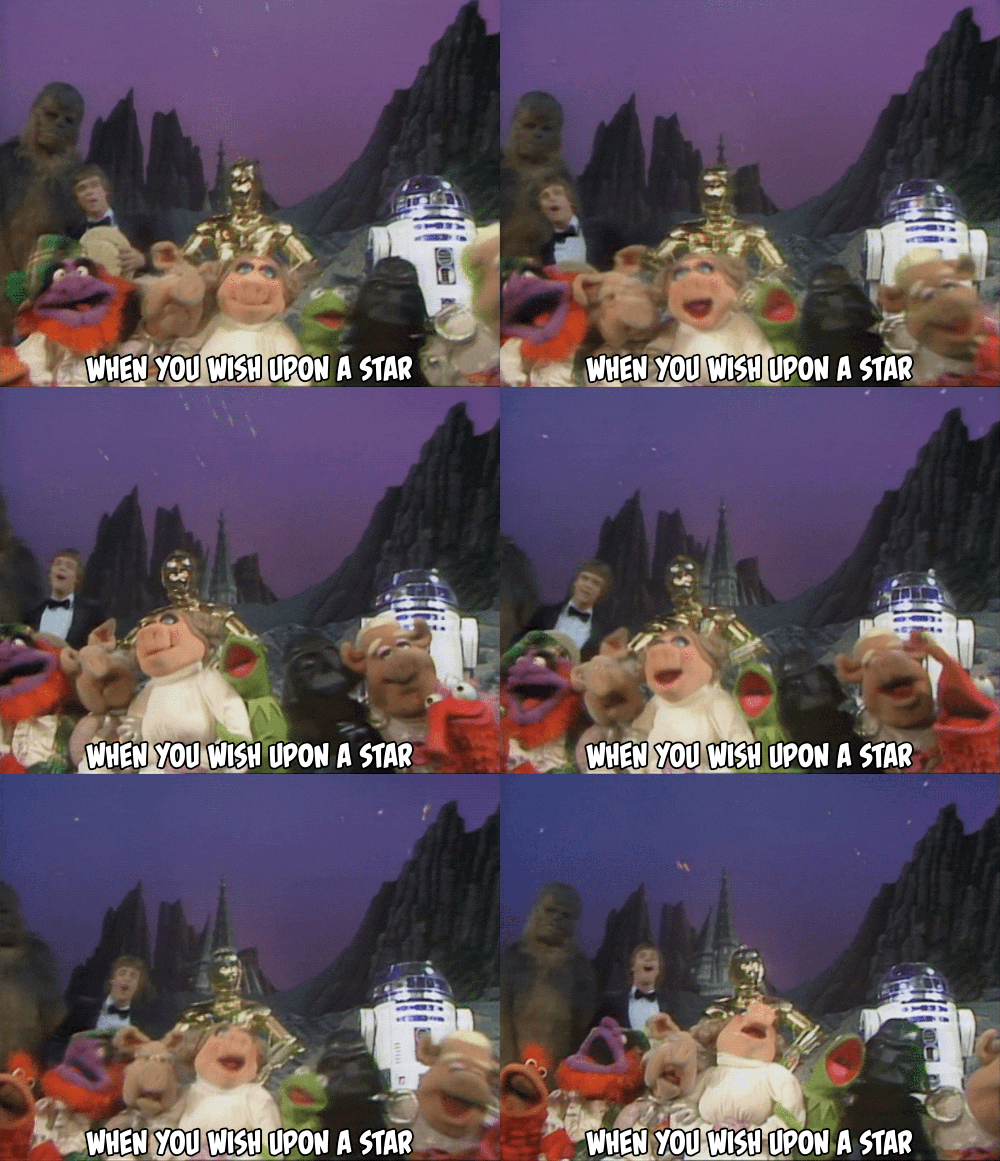
The problem for Toobworld Central began with the appearance of the "Star Wars" cast on 'The Muppet Show', especially for Hamill.  He was on the show not only as himself but also his "cousin" Luke Skywalker.

In the old days of my televisiological research, I think I may have sprained something in trying to come up with the pretzel logic needed for the "splainin to do."  I mapped it out with the use of vortexes, time travel, theories of relateeveety....  I finally said "Bleep that" to all the feldercarb and paid obeisance to Occam's Razor:  "One should not make more assumptions than the minimum needed."


Therefore, Mark Hamill was appearing on that episode only as himself.  And he was playing Luke Skywalker as he did in the movies.  The same held true for Mr. Mayhew when he was seen in the Chewbacca outfit on the show.  That holds true for his appearances as Chewbacca in 'Glee', ‘Donny And Marie’, and in several commercials.  


I've yet to check out all the commercials, but it could be that the only time he actually was Chewbacca on television was in "The Star Wars Holiday Special".  I'm sure George Lucas hates this, but for Toobworld Central, the live-action segments of that are part of the Cineverse, just as the animated bits are accepted into the Tooniverse.


Related image

So here are Peter Mayhew’s credits which qualify him for membership in the Television Crossover Hall of Fame.  In some, he’s simply Peter Mayhew; in others, he’s seen in his costume as Chewbacca.


Donny and Marie
- Episode #3.1
(1977)

... Chewbacca

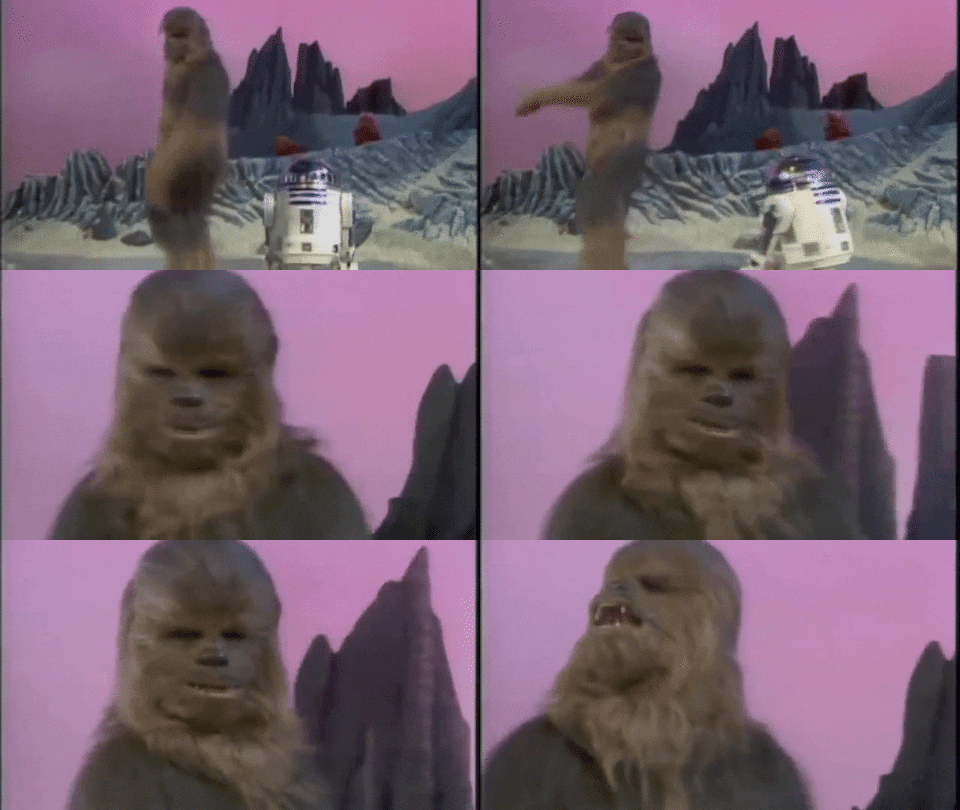
Also in this episode were Redd Foxx, Paul Lynde, and Kris Kristofferson, with Anthony Daniels as C-3PO.  R2-D2 was there as well, but probably fully automated; there’s no mention of Kenny Baker being involved.  As for Darth Vader, his voice was provided by the great Thurl Ravenscroft, voice of Tony the Tiger and the singer of the Earle Hagen songs in “How The Grinch Stole Christmas”.


So I think it’s safe to assume that it has to be Peter Mayhew under that yak fur – accept no substitutes! – and not the real Chewbacca,


The Muppet Show
- The Stars of Star Wars
(1980)

... Chewbacca

From the IMDb:
While the Star Wars characters search for Chewbacca around the theatre, Luke's cousin, Mark Hamill, offers to perform over the objections of the Gershwin gargling guest star, Angus McGonagle.  


Since I used this as the example at the beginning, I’m standing by it – we’re seeing Peter Mayhew as Chewbacca, not Chewbacca himself.


No 73 
- The Disagreement
(1983) ... Himself  


From the IMDb:
Ethel is building a hovercraft in the yard. Alec is asking viewers to call-in to suggest an ending to his play. Martin from No 75 is complaining about the noise. Peter Mayhew drops by to talk about “Return of the Jedi”.


O'Bservations:
One of only two appearances as himself without the costume being involved in any way, although they do talk about Chewie.  


Ethel Davis:
You know, I'd make terrible bookends with you.
Peter Mayhew:
Depends on the size of the books, don't it?
Ethel Davis:
That's true. How tall are you?
Peter Mayhew:
I'm seven foot ten.
(O’Bservation – to my ears, it sounds like he said 7-foot-two.)

Ethel Davis:
I'm four foot twelve.
Do you mind if we just have a measure?


Late Show with David Letterman
- Ray Romano/Dave Matthews Band
(2005)

... Chewbacca / Top Ten List Presenter

From the IMDb:
The 'Top Ten List' segment with topic 'Things Never Before Said By a "Star Wars" Character' is presented by dressed up characters from the Star Wars movies. The Chewbacca costume was actually worn by the real Chewbacca actor Peter Mayhew.  

Top Ten Things Never Before Said By A "Star Wars" Character
10. C-3PO: "May the Force be with the Miami Heat--daddy's got 20 large riding on them."
9. Storm Trooper: "Ask your doctor or pharmacist if Cialis is right for you."
8. Ewok: "Seacrest, out!"
7. Darth Maul: "The only good thing ever to come from planet Earth is fish sticks."
6. R2-D2: "I just hooked up backstage with an ice machine."
5. Imperial Guard: "The only people more powerful than I are Emperor Palpatine and Oprah."
4. Chewbacca: "We got spaceships and lightsabers, but nobody can find me a damn razor."
3. Jango Fett: "Let's put on some Al Jarreau so me and you can get freaky."
2. Tuscan Raider: "How bad is CBS screwed without 'Everybody Loves Raymond'?"
1. Darth Vader: "I once used the force to open a jar of Vlasic kosher pickles."


Glee
- Extraordinary Merry Christmas
(2011)

... Chewbacca (uncredited)

From the IMDb:
When the Glee Club is asked to perform at two different events, on the same day, at the same time, they have a difficult decision to make.  


News source:

THR is reporting that everyone’s favorite Star Wars Wookiee, Chewbacca, is making a guest appearance on Fox’ “Glee.” This has been further verified by cast members Chris Colfer, Harry Shum Jr. and Mark Salling who recently tweeted personal photos with Chewie. We’re unsure how Chewie fits in with the teen musical series, but if you’re a “Star Wars” fans it may be worth checking out even if you don’t watch (or hate) the show.

Breaking In
- Episode XIII
(2012)

... Peter Mayhew

From the IMDb:
Molly's uncle, “Star Wars” star Peter Mayhew, hires the delighted Contra team to retrieve his stolen Chewbacca costume for a fortune. Oz hopes that will enable him to buy the firm back from OCP, but still finds Veronica's help indispensable.  


O’Bservation:
This episode puts Peter Mayhew in a select group of League of Themselves members whose televersions re actually related to fictional characters of Toobworld.

Others in that club with Mr. Mayhew include:
  • Tim & Luke Russert, cousins with Megan Russert (‘Homicide: Life On The Street’)
  • Art Carney, cousin to Vera Louise Gorman (‘Alice’)
  • Bryant and Greg Gumbel, related to Sammy (‘The Nanny’)
  • Nat “King” Cole, older cousin to Little Jimmy (‘The Jack Benny Program’)
  • And now the character of Molly Hughes has a relative who originates from Earth Prime, with the televersion of Peter Mayhew as her uncle.
Now let’s take a look at some of the commercials in which we saw “Chewbacca”:

PEPSI COMMERCIAL

O’Bservation:
Apparently, this is raw footage for the finished product, but you can hear the director address Mr. Mayhew as “Peter”.  Therefore it has to be Peter Mayhew under the fur suit.

CURRY’S COMMERCIAL


O’Bservation:
I see no reason to consider this anything but Peter Mayhew in costume as Chewbacca.

CINGULAR COMMERCIAL

O’Bservation:
It’s hardly likely that the studio producer was able to travel back in time to retrieve the real Chewie to do the ringtone recordings.  So another point in Mr. Mayhew’s favo

One last O’Bservation about the blipverts which were made in connection to “Solo”, the last “Star Wars” movie to be released so far: by this point in the history of the franchise, Mr. Mayhew was basically retired from the films.  And again, we’re celebrating the man in the suit, not the character of Chewbacca.


Welcome to the Hall, Peter Mayhew.  As mentioned earlier, your co-star Mark Hamill will eventually be inducted, in the same category as you are – as a member of the League of Themselves.  But as Obi Wan Kenobi pointed out, “There is another.” 


Near the end of 2017, we inducted Carrie Fisher as a memorial tribute for her contributions to Toobworld as a member of the League of Themselves.  And because they passed away so close together, within days of each other, we inducted her mother Debbie Reynolds at the same time for her contributions as well.

Good night and may God bless, Peter Mayhew.  May the Force be with you….


Related image


Friday, May 3, 2019

TVXOHOF: MAY 2019 - WONDER WOMAN!


Every May we make sure to induct a woman, Queen of May in a way, just to make sure we inject some feminine pulchritude into the TV Crossover Hall of Fame.  And this year we are inducting superheroes and villains in the monthly showcase.  So… a TV superhero in May who should be female?


Who else could it be but….


WONDER WOMAN!

From Wikipedia:
Wonder Woman is a fictional superhero appearing in American comic books published by DC Comics. The character is a founding member of the Justice League. The character first appeared in All Star Comics #8 in October 1941 with her first feature in Sensation Comics #1, January 1942. The Wonder Woman title has been published by DC Comics almost continuously except for a brief hiatus in 1986.  In her homeland, the island nation of Themyscira, her official title is Princess Diana of Themyscira, Daughter of Hippolyta. When blending into the society outside of her homeland, she adopts her civilian identity Diana Prince.

Wonder Woman was created by the American psychologist and writer William Moulton Marston (pen name: Charles Moulton), and artist Harry G. Peter. Marston's wife, Elizabeth, and their life partner, Olive Byrne, are credited as being his inspiration for the character's appearance.

Marston's comics featured his ideas on DISC theory, and the character drew a great deal of inspiration from early feminists, and especially from birth control pioneer Margaret Sanger; in particular, her piece "Woman and the New Race".


Wonder Woman's origin story relates that she was sculpted from clay by her mother Queen Hippolyta and was given a life to live as an Amazon, along with superhuman powers as gifts by the Greek gods. In recent years, DC changed her background with the revelation that she is the daughter of Zeus and Hippolyta, jointly raised by her mother and her aunts Antiope and Menalippe. The character has changed in depiction over the decades, including briefly losing her powers entirely in the 1970s; by the 1980s, artist George Perez gave her a muscular look and emphasized her Amazonian heritage. She possesses an arsenal of advanced technology, including the Lasso of Truth, a pair of indestructible bracelets, a tiara which serves as a projectile, and, in older stories, a range of devices based on Amazon technology.


Wonder Woman's character was created during World War II; the character in the story was initially depicted fighting Axis military forces as well as an assortment of colorful supervillains, although over time her stories came to place greater emphasis on characters, deities, and monsters from Greek mythology. Many stories depicted Wonder Woman rescuing herself from bondage, which defeated the "damsels in distress" trope that was common in comics during the 1940s.

In the decades since her debut, Wonder Woman has gained a cast of enemies bent on eliminating the Amazon, including classic villains such as Ares, Cheetah, Doctor Poison, Circe, Doctor Psycho, and Giganta, along with more recent adversaries such as Veronica Cale and the First Born. Wonder Woman has also regularly appeared in comic books featuring the superhero teams Justice Society (from 1941) and Justice League (from 1960).

The character is a well-known figure in popular culture that has been adapted to various media. June 3 is Wonder Woman Day.  Wonder Woman is part of the DC Comics trinity of flagship characters alongside Batman and Superman.


Wonder Woman has been featured in various media from radio to television and film, and appears in merchandise sold around the world, such as apparel, toys, dolls, jewelry, and video games. Shannon Farnon, Susan Eisenberg, Maggie Q, Lucy Lawless, Keri Russell, Michelle Monaghan, Rosario Dawson, Cobie Smulders, and Halsey among others, have provided the character's voice for animated adaptations. Wonder Woman has been depicted in both film and television by Cathy Lee Crosby, Lynda Carter, and Gal Gadot.

Wonder Woman has made multiple appearances in television, including the 1974 made-for-television film Wonder Woman, and most notably Hanna-Barbera's long-running animated series Super Friends as well as the 1970s live-action show Wonder Woman.  

Wonder Woman, known for seasons 2 and 3 as The New Adventures of Wonder Woman, is an American television series based on the DC Comics comic book superhero of the same name. The show stars Lynda Carter as Wonder Woman/Diana Prince and Lyle Waggoner as Steve Trevor Sr. & Jr. It originally aired for three seasons from 1975 to 1979.  The show's first season aired on ABC and is set in the 1940s during World War II. The second and third seasons aired on CBS and are set in the 1970s, with the title changed to The New Adventures of Wonder Woman, and a complete change of cast other than Carter and Waggoner. Waggoner's character was changed to Steve Trevor Jr., the son of his original character.


From the IMDb:

After a dogfight with a Nazi plane, U.S. Air Force Steve Trevor crashlands on an uncharted island in the Bermuda Triangle. Paradise Island is inhabited only by women, and their existence has been kept a secret for thousands of years. Learning of the Nazi threat to humanity, the Amazon princess, Diana, is chosen to accompany Trevor back to the United States to battle the Third Reich. Garbed in a skimpy red, white & blue costume and armed with a magic lasso that forces anyone within its grasp to tell the truth, Diana uses her powers as Wonder Woman to battle the forces of evil.

In the story, Major Steve Trevor flies to the Devil's Triangle to intercept a Nazi plane headed to bomb the U.S. Both planes are destroyed, and as the two pilots parachute toward land, the Nazi shoots Steve. He lands on the shores of Paradise Island, where he's discovered by two of the beautiful Amazon women living there. One just happens to be the Princess, the only daughter of the Queen (though that would be contradicted later in the season), and this quite dewy-eyed princess can't help but nurse the ailing Trevor back to health. When the Queen sets an athletic competition to determine which Amazon will return Trevor to his home (before his savage manly ways corrupt the tranquil island, you understand), the Princess, forbidden by her mother to compete, wins the contest is disguise. She hops her invisible jet to the U.S. War Department, her precious cargo in tow.


Carter's star-spangled superheroine is wide-eyed and sweet as she experiences Washington, D.C., for the first time, causing a sensation strolling down a crowded street in her unique attire, and even bemusedly offering social commentary after stopping a robbery and being asked to "fill out forms." She's approached by a theatrical agent, who promptly makes some cash off her bullets-and-bracelets act but then tries to swindle her. But he's got another angle he's working, anyway.


The Nazi plot thickens, and though Wonder Woman has an innocent quality about her, she veers to the highly shrewd as she works to unravel the scheme. In a key historical moment (and a move that was mimicked by little girls everywhere!), we see Diana twirl to transform into Wonder Woman for the first time. (Lynda Carter explains in the special features for the first-season DVD set that the twirl was her suggestion when the producers were looking for some way for Diana to change into her alter ego.)


Comic books, TV movies, TV series, cartoons, movies.  I’ve written about the televersion of the multiversal Wonder Woman in the past:


WONDER WOMAN – DC UNIVERSE VS. TOOBWORLD

WHITE COLLAR REFERENCE FOR WONDER WOMAN

O’BSERVATIONS ON WONDER WOMAN 

MARY RICHARDS AND WONDER WOMAN


The first two qualifications for Wonder Woman’s inclusion in the TVXOHOF are on solid ground.  First we have the pilot movie, “The New Original Wonder Woman” and then her three season series.  One year was broadcast on ABC and then the next two seasons on CBS.


That first season was set during World War II but the timeline then advanced to the “present day” of the mid-1970s.  Once Wonder Woman began making a name for herself in battling the Third Reich, my trusty “Zonk Alibi” – the shadow ops group UNReel – sprang into action.  They were the instigators behind the Marstons and Peter creation of the comic book so that the general public would come to believe that she was really fictional, and maybe serving as a morale booster in the war effort.  This would allow the real Wonder Woman to continue on her mission to “defeat the Hun.”  (How jingoistic.)


Lynda Carter's third appearance as Wonder Woman marks her as a TV multidimensional on her own.  In 1976, she played the role in a sketch for "A Special Olivia Newton-John".  And she remained in character.


There's more to confirm Wonder Woman's existence in Toobworld than just her actual appearance.  For instance, we know that the UNReel project worked.  Young Mary Richards used to read the Wonder Woman comic book….


‘The Mary Tyler Moore Show’
“Anyone Who Hates Kids And Dogs”


MARY:
I used to like comic books when I was your age. I used to love Wonder Woman. Do you know her?
STEVIE:
Sure.


MARY:
I used to love the way she’d ward off bullets with her golden bracelets. Gee, every month I couldn’t wait for the next issue to come out. Oh, I remember this one story when Egg Fu, her archenemy, had her trapped in this giant mustache of his. And he had her tied up in one end of the mustache, and in the other end of the mustache was her boyfriend, uh …
SUE ANN:
Steve Trevor.
MARY:
Right. Right. Well anyway just before Egg Fu was about to crush them both, Wonder Woman worked her arm free and twirled her magic lasso around his head and she cracked it into a thousand pieces, and the world was safe for democracy once again. I just thought it was wonderful. Do you like Wonder Woman?
STEVIE:
Naw, she’s too butch.


Nothing about Mary’s dialogue gives any indication that she thought Wonder Woman was a real person, so UNReel’s efforts had been successful. 

There is a discrepancy in her reminiscence that needs to be rectified: the comic first came out when Mary Richards was a year old.  (By contrast, Mary Tyler Moore was five years old.)  So she probably got into comic books around 1950, when she turned ten years old.

That infatuation with Wonder Woman lasted into her mid-twenties because she was twenty-five years old when that issue of “Wonder Woman” with Egg Fu came out.


From the IMDb:
The villain in the Wonder Woman comic book Mary talks about - 'Egg Fu' - first appeared in 1965. Mary said she read Wonder Woman as a child, but Mary Richards was in her mid-twenties, at the time.

There’s no Zonk here.  Mary told that little snot Stevie that she liked comic books when she was his age.  She just never said when she stopped liking them. 


By the 1970s, when Wonder Woman reappeared in public to battle crime (although I think she surreptitiously did so in the interim, which would allow me to incorporate this photoshopped picture into the Toobworld Dynamic), UNReel upped their game to cover for her by financing the Toobworld version of her TV series.  (It would not be the exact same TV series which we saw.  As was the case with other TV shows with televersions, there would be episodes which were never seen in the Real World.)


And we know that the televersion of Lynda Carter would be the star of that show as the Real Lynda Carter was in the Real World. Proof of that comes from yet another TV series:


‘Two And A Half Men’
“Justice In Star-Spangled Hot Pants”


Alan:
That woman with your mom looks just like Lynda Carter.
Walden:
That is Lynda Carter.
Alan:
Really? Wait, wait, T-TV's Wonder Woman? The jewel of Paradise Island? The-the shining crusader for justice in star-spangled hot pants?
Walden:
I just call her Lynda.
Alan:
And I just lost the cleaning deposit on this tux.


Walden:
Lynda, you look amazing.
Lynda:
Oh, my God. The last time we saw each other, you barely came up to here.
Walden:
I remember those days.


So that Zonk about ‘Wonder Woman’ being a TV show within another TV show was resolved by the same UNReel splainin for the comic books.

And then we have this reference:

‘Hope & Faith’
“Phone Home For The Holiday”


From the IMDb:
Faith and Hope approve of her Dad's new girlfriend until she admits that she was kidnapped by aliens.


Lynda Carter wasn’t appearing as herself; she played Summer Kirkland, the girlfriend. When the girls realized the heartbreak they caused their father by breaking them up, Hope and Faith disguised themselves as stewardesses to get on Summer’s flight and convince her to come back; their father wanted to marry her.  Unfortunately, the doors were shut and the plane was making ready for takeoff.  Summer took charge and bellowed for the doors to be opened back up again.  This caused Faith to remark to her sister, “Wow.  Check out Wonder Woman!”


This could be a combination reference – Faith may have noticed Summer’s “uncanny” (nudge nudge, wink wink) resemblance to Lynda Carter, which could mean that she was a fan of the TV series; she may also have read the comic books; and by the new millennium, the veracity of Wonder Woman’s existence may have already been exposed and confirmed to the general public.

If you refer back to that Inner Toob link to “An O’Bservation On Wonder Woman”, you’ll see the Super Six List of TV characters who dressed up as Wonder Woman.  Their inspiration for the costume could also come from the same set of references – the comic books, the TV series, both of which were based on the Real Wonder Woman.


(Here's one that wasn't used in that Super Six List.  This was a philandering couple at a costume party in an episode of 'Hart To Hart'.)

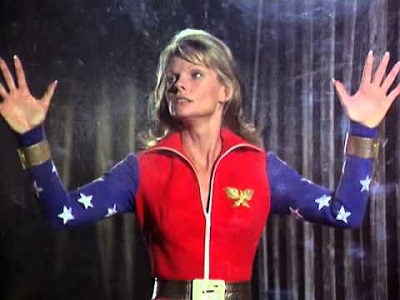
Within the greater TV Universe, Wonder Woman is a multidimensional.  Before Lynda Carter wore the stars and stripes, Cathie Lee Crosby assayed the role in a one-off TV movie which is set in a different TV dimension.  And that difference in appearance?  A different blob of clay was used to build her, I guess.


And then there was the 2011 failed pilot for a new version starring Adrianne Palicki.  That exists in Toobworld2, the land o’ remakes.


And of course, there is the Wonder Woman of the Tooniverse.  No matter the differences in artistic style, she is always the same character.


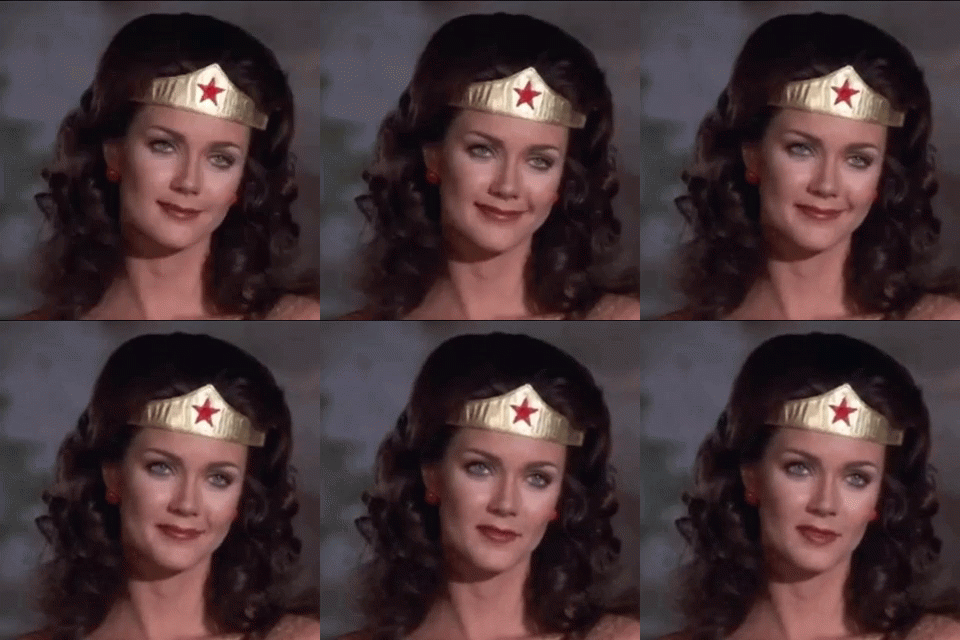
So if you don’t like the idea that Wonder Woman is being inducted based on inference, then think of her as the multidimensional, with Lynda Carter being the official face of the character based on her numerous appearances in the role.


And to finish up, here's one last photoshopped picture that could have happened.  Definitely inspiration for some fanfic, don't you think?


Oh!  As another member of the Television Crossover Hall of Fame (Class of 2005) would often say, "Just one more thing...."

I'd like to make a suggestion to any TV producers out there whose assistants (the ones that do the heavy lifting) might stumble across this blog post: bring back Lynda Carter as Wonder Woman.

Yes, I know she has aged, but not drastically so.  Yet it could play into what I have in mind....

Lynda Carter could play Wonder Woman far in the future.

We saw that Queen Hyppolita, first played by Cloris Leachman and then Carolyn Jones, showed signs of age during the course of the series.  So would be the situation for Wonder Woman.  And that's why it should be a show which is set in the future.

Even better?  Make it a guest appearance in a TV series that travels into the Future.  And what could be a better showcase than a series which is licensed by DC Comics?

Let's have Lynda Carter show up as Princess Diana in the far Future on an episode of 'Legions of Tomorrow'.  We've already seen her homeland of Themyscira make a cameo on an episode of the show.  So the option would be viable.


Of course, this would mean that she would be playing Wonder Woman in yet another TV dimension, but she's already proven that she does exist in other TV worlds as played by Ms. Carter.


So here’s to you, Wonder Woman! Welcome to the Television Crossover Hall of Fame!


BCnU!

I'm dedicating this post to three fans of Wonder Woman - my cousin Coco Manson, a dear friend, Mark Thompson, and my blogging buddy Rob Buckley.  More than anybody else, I hope you three enjoyed this....


Related image


Thursday, May 2, 2019

THEORIES OF RELATEEVEETY - THE FOUQUETS


“THE MAN IN THE IRON MASK”


From Wikipedia:
Nicolas Fouquet, marquis de Belle-ÃŽle, vicomte de Melun et Vaux (27 January 1615 – 23 March 1680) was the Superintendent of Finances in France from 1653 until 1661 under King Louis XIV. He had a glittering career, and acquired enormous wealth. He fell out of favor, accused of peculation (maladministration of the state's funds) and lèse-majesté (actions harmful to the well-being of the monarch). The king had him imprisoned from 1661 until his death in 1680.

Fouquet's story is often entwined with that of the Man in the Iron Mask, who is often identified as the true king or even as an identical twin brother of Louis XIV.

As such, he is a pivotal character in Alexandre Dumas' novel “The Vicomte de Bragelonne”, where he is depicted heroically. Aramis, an ally of Fouquet, tries to seize power by replacing Louis XIV with his identical twin brother. It is Fouquet who, out of sheer loyalty to the crown, foils Aramis' plot and saves Louis. This does not, however, prevent his downfall.

In the 1977 TV movie “The Man In The Iron Mask”, the characters of Fouquet and Aramis are reversed as far as hero and villain are concerned, and the plot does prove successful.  And that’s how History stands in Toobworld.

‘THE SAINT’
“JEANINE”


Only in Earth Prime-Time, Fouquet’s family tree led to a descendant named Raymond Fouquet, born in 1920.  In 1964, he plotted to steal a string of pearls which belonged to Madam Chen, the wife of the leader of East Viet Phieu.  Standing in his way was the modern Robin Hood, Simon Templar.

BCnU!


Wednesday, May 1, 2019

WIKI TIKI WEDNESDAY - A SPECIAL GUEST APPEARANCE


On Sunday, April 28 of this past year, Greg Williams published this article on the Facebook page for “The Dick Van Dyke Show” book.  The year has ¾ of the way to go and a Toobits Award for 2019 has already been locked in.  Greg has secured it for Best Televisiological Research for this article:


Tony Pastor and the Origins and Impact of Vaudeville —

Many viewers notice that the display of photos and posters on the office wall in “The Sick Boy and the Sitter” (episode # 1) offer a unique glimpse into the decorating style of the series.  Most of what we see here never resurfaces in subsequent episodes.  The pictures, which appear to have a common show-business theme, probably came from the prop department at Desilu-Cahuenga, if not from the sets of other shows – such as The Danny Thomas Show – currently filming there.  The uncertain status of the new Van Dyke series made it necessary to be careful about budgeting, which naturally influenced the thrown-together look of the actors’ working spaces.  


One of the posters features Tony Pastor’s Show.  A careful look shows the date on it as Monday, February 5.  We only see the poster fleetingly, and it is never used again.  Later episodes feature Van Gogh prints and The Dairy Maids music sheet rather than the array of pictures and photos we see in “The Sick Boy and the Sitter”.  However, we do hear about Tony Pastor again.  In “Hustling the Hustler” (episode # 35), Rob and his co-writers put together a skit involving Diamond Jim Brady attending a show . . .  at Tony Pastor’s.  The reference is likely obscure to most current viewers.  

The poster in “The Sick Boy and the Sitter” includes a large number of names:
  • Prof. Heller Outdone
  • Pat Rooney
  • Scanlon A. Cronin
  • Sam Devere
  • Clifton A. Forepaugh
  • The Empire Children
  • Foy Sisters
  • Moonlight Shadows
  • Great Bennetts
  • Tony Pastor
  • Miss Kittie O’Neil
  • The French Sisters
  • The Long Brothers
  • Miss Erba Robeson
  • The Sankey Family
The year during which the show took place is difficult to pin down.  It could be 1866, 1872, 1877, 1883, 1894, 1900, 1906, 1912, 1917, 1923, or 1934 – the only years during the heyday of vaudeville when February 5 fell on a Monday.  Tony Pastor, the one-time child performer and revered impresario often called “The Father of Vaudeville” (Anthony Slide, The Encyclopedia of Vaudeville, p. 390), lived from 1837 to 1908.  More than anyone else, he is responsible for bringing to the vaudeville stage family-friendly entertainment, thereby making it suitable for general audiences.  As the list of performers on the poster in “The Sick Boy and the Sitter” indicates, he actively promoted other performers, many of whom he introduced around the country before the invention of wide-reaching radio technology.  Two biographies of Pastor have been published: Parker Zellers’ Tony Pastor: Dean of the Vaudeville Stage (1971) and Armond Fields’ Tony Pastor: Father of Vaudeville (2007).  Because of the date of his death, the years 1912, 1917, 1923, and 1934 can be discounted.

The names on the poster offer additional clues about the show’s date.  The most familiar name on the poster, besides Pastor’s, is Pat Rooney.  Notice that it is set out in large, bold letters.  At first it is not absolutely clear whether this is Pat Rooney Sr. (1848-1892) or Pat Rooney Jr. (1880-1962).  Sam Devere – whose name is also in large type – is a character of some notoriety from the time of the Civil War to the 1880s whose place in the show helps establish that the poster refers to Pat Rooney Sr.  According to Trav S. D., the author of No Applause – Just Throw Money, Devere, active on the stage from the time of the Civil War to the 1880s, “was reputed to have beaten a man to death with his banjo during an unwelcome brawl in Texas” (p. 43).  Besides his extraordinary banjo playing and his infamy arising from the ruckus in Texas, Devere is best known for composing “The Whistling Coon” (1888), part of “a growing repertoire of pseudo-Negro material of the less respectful type” (Sigmund Spaeth, A History of Popular Music in America, p. 242).

Kittie O’Neill (ca. 1852-93) was a popular singer and dancer in the 1870s and 80s who is best known today as the woman whose name occurs in the title of the song “Kitty O’Neill’s Champion Jig” (whose seventh part is a possible inspiration for The Dick Van Dyke Show’s theme song).  She began singing on stage at an early age – hence the use of the word “Miss” on the poster.  The date of O’Neill’s death rules out the years 1894, 1900, and 1906, as possible dates for the show advertised on the poster.  Erba Robeson (1868-1935) is also called “Miss” on the poster, another good indication that the Pastor’s show took place no later than the 1880s.  Her birthdate rules of the years 1866 and, probably, 1872 as the date of the advertised show.

We now come to the Foy Sisters.  At first it might be thought that these were Madeline and Mary, two of “The Seven Little Foys” (1910-13), children of the sialoquent Eddie Foy (1856-1928).  But Madeline (1906-88) and Mary (1901-87) are clearly too young.  It turns out that there was an earlier set of Foy Sisters, dancers in the 1870s, who so charmed a young performer named Edwin Fitzgerald that he decided to assume the stage name Eddie Foy (Arnoud Fields, Eddie Foy: A Biography of the Early Popular Stage Comedian, p. 17).  Foy, strangely enough, is buried with six of his seven children at the Holy Sepulchre Cemetery in New Rochelle, about 20 minutes away from the one-time Reiner residence at 48 Bonnie Meadow Road.

From newspaper advertisements from the 1870s it can be shown that the Foy Sisters were members of Tony Pastor’s troupe, “The Largest and Best Company in America,” at least as early as 1875.  Most tellingly, an ad from the New York Evening Express, dated February 9, 1877, identifies almost the entire line-up of performers listed on the poster on the writers’ office wall.  The date on the poster is, therefore, almost certainly Monday, February 5, 1877.  

So who was Tony Pastor anyway?  Pastor started out at the age of ten performing as a blackface minstrel, eventually becoming a saloon singer and songwriter before refocusing his entertainment aspirations as a show producer.  He invented the family-oriented “variety show” – the kind of programming that The Alan Brady Show represents as a modern incarnation.  Tony Pastor’s Opera House and his other theaters served as the principal showcases for many first-rate vaudeville performers, effectively making him one of the seminal figures in the development of the medium.

Vaudeville was a popular light entertainment vehicle in the United States from the mid-1890s to the early 1930s.  It is mentioned in “The Boarder Incicent” (episode # 20), when Rob remarks to Buddy, “I’m surprised you still have that cello.  I thought you got rid of it when you quit vaudeville”.  At each show several unrelated acts would appear on the program together.  Among the big-name celebrities appearing in or referred to in The Dick Van Dyke Show who appeared on the vaudeville circuit were Abbott and Costello, Fred Allen, Morey Amsterdam, Jack Benny, Milton Berle, Eddie Cantor, George M. Cohan, Sammy Davis Jr., Jimmy Durante, W.C. Fields, Cary Grant, Bob Hope, George Jessel, Al Jolson, The Marx Brothers, Donald O’Connor, Will Rogers, Mickey Rooney, Rose Marie, Red Skelton, and Sophie Tucker.

How vaudeville came about has taxed historians’ minds for ages.  The word itself may come from vaux-de-vire, which refers to 15th-century satirical or drinking songs in Normandy, France, or from voix de ville, which literally means “voice of the city”.  The name, whatever its derivation, came to be applied to theatrical shows in the early 18th century and, later, to variety shows on the American frontier and throughout the nascent urban centers in the United States and Canada.  Seminal figures in the development of vaudeville, besides Tony Pastor, include Benjamin Franklin Keith (1846-1914), and Edward Franklin Albee (1857-1930).  Vaudeville eventually declined, largely as a result of the emergence of motion pictures, especially after the introduction of sound in 1927, and of radio and television.  Ironically, television not only dealt vaudeville its final lethal blow but also generated the first wave of nostalgia surrounding it by packing its airwaves with variety shows, including those of Milton Berle, Sid Caesar, Jack Benny, Ed Sullivan, and Jackie Gleason – all of whom are mentioned in episodes of The Dick Van Dyke Show, which of course focuses on the escapades of the head writer of a vaudevillesque variety show – and who, as in “The Sick Boy and the Sitter,” often performs in skits and musical numbers at parties along with his peers.

Vaudeville can be seen as a “democratic art” (LeRoy Ashby, With Amusement for All, p. 119).  As an entertainment medium that targeted middle-class audiences, it balanced the gradual emergence of star power against the humble origins of much of the material out of which its shows were constructed.  To put it another way, vaudeville mixed celebrity and popular taste in a dialectic of cultural ambiguity.  According to Ashby, “it moved, unevenly and crab-like, from the margins of the amusement industry to the center of mass entertainment” (p. 119), but always with democratizing principles close at hand.  Not only did it cobble together diversions of all sorts from a wide range of sources but also it united the country as the medium’s network of theaters, including The Palace in New York City, came to be formalized as a national circuit.  Reflecting the tastes of the ticket-buying public, it followed a series of strongly entrenched rules about vulgarity and sexual explicitness.  Words like “liar,” “son-of-a-gun,” “devil,” “sucker,” “damn,” “hell,” “spit,” and “cockroach,” were forbidden as part of an overall strategy of keeping the shows family friendly (Ashby, p. 120) and consistent with mainstream values.  

Vaudeville, for all its democratizing ways, was also a hotbed of racial and ethnic stereotyping.  Jews, Italians, the Irish, natives, and blacks, among others, were targets of merciless derogatory humor and condescending depiction, despite the large number of them who found decent work on the circuit.  Over time objections to the patronizing and degrading portrayal of such “types” resulted in serious campaigns to downplay them – but not, it seems, out of concern for the affected groups but out of respect for the bottom line.  Theaters owners did not want to offend their patrons – so in addition to bad language and suggestive acts, they gradually got rid of grotesque misrepresentation and stereotyping.  By the late 1950s and the early 1960s most of the stereotypes had been eradicated from the performing arts (theater, film, radio, television, and popular music) but the memory of the bad old days of hurtful treatments of the more vulnerable targets – blacks, in particular, but also (as evidenced in The Dick Van Dyke Show) native Americans, who are usually shamelessly called “Indians” (see, for example, episodes # 2, 69, 70, 78, 79, 109, 123, and 152) – brought about a production culture of using overcompensating measures to rectify the balance.  The Dick Van Dyke Show famously had to struggle to integrate blacks into several episodes because of the obtuse misgivings of networks hacks, whose efforts reflected the continuing sinuous hold of vaudeville on mid-century popular culture. – Greg

Incredible work!  From one rather insignificant prop, a whole world has been uncovered.

Congratulations, Sir!


Tuesday, April 30, 2019

LOCATION SHOT - SCOTLAND YARD IN TOOBWORLD


SGT. O’KEEFE:
I expect you've seen pictures
of the New Scotland Yard, Lieutenant.
LT. COLUMBO:
That looks pretty new to me.
O’KEEFE:
The New Scotland Yard was the old headquarters.
COLUMBO:
Uh, but it wasn't old Scotland Yard?
O’KEEFE
No, no. It was New Scotland Yard.


From Wikipedia:
Scotland Yard (officially New Scotland Yard) is a metonym for the headquarters of the Metropolitan Police Service (MPS), the territorial police force responsible for policing most of London.

The name derives from the location of the original Metropolitan Police headquarters at 4 Whitehall Place, which had a rear entrance on a street called Great Scotland Yard. The Scotland Yard entrance became the public entrance to the police station, and over time the street and the Metropolitan Police became synonymous. The New York Times wrote in 1964 that just as Wall Street gave its name to New York's financial district, Scotland Yard became the name for police activity in London. This building was acquired by hypermarkets operator Lulu Group International in 2015 and redeveloped into a luxury hotel, which is planned to open in summer 2019.

The force moved from Great Scotland Yard in 1890, to a newly completed building on the Victoria Embankment, and the name "New Scotland Yard" was adopted for the new headquarters. An adjacent building was completed in 1906. A third building was added in 1940. In 1967, the MPS moved its headquarters from the three-building complex to a tall, newly constructed building on Broadway in Victoria. In summer 2013, it was announced that the force would move to the Curtis Green Building – which is the third building of New Scotland Yard's previous site (1890–1967) – and that the headquarters would be renamed Scotland Yard.

In November 2016, MPS moved to its new headquarters, which continues to bear the name of "New Scotland Yard."


Here we see New Scotland Yard as seen in an episode of ‘The Saint’ from 1964, followed by New New Scotland Yard from that ‘Columbo’ episode set in London, “Dagger Of The Mind”.

BCnU!


Monday, April 29, 2019

BORN TO RERUN - DE-ZONKING "COLUMBO"


‘NCIS: LA’

“TIL DEATH DO US PART”


Roberta Deeks:
“Columbo solved hundreds of murders;
never even carried a gun.”

When Debbie Greenfield, one of the Columbo-TV admins on Facebook posted this information, this is the comment I left:

No mention of the show; she talked of Columbo as though he was real. And she spoke of him solving hundreds of cases whereas we only saw 69 of them. And maybe at most twenty others mentioned/referenced. I think all of that helps support a claim that both shows exist in the same TV dimension. Thanks, Debbie!  You made this Crossoverist very happy....

Inner Toob is a blog.  Unlike a sedentary website where it might be easier to track down the information… information… information, the info is constantly flowing through the system.  So for those who are members of Team Toobworld and are already familiar with my thoughts about Lt. Columbo and his status in the TV Universe, forgive me.  I’m going through it again for the sake of any newcomers.

Here in the Real World there have been many celebrated detectives whose fame has grown from the work they have done.  And the same would hold true in Toobworld.  And Lt. Frank Columbo would be one such detective.  After all, look at the types of murderers he has arrested over the years – world-famous actors, politicians, authors, publishers, composers, conductors, and military men.  Even a magician.  Those are the type of killers who are going to make the newspaper headlines and even the evening news.

So that alone would have made it possible for Roberta to know of him.  But there’s more – it’s possible that Columbo finally acted on his idea of writing a book (mentioned in “Publish Or Perish”.)  And in covering the cases he solved with so many infamous murderers, it more than likely became a best-seller.

That book eventually led to a TV series starring Peter Falk who bore an incredible likeness to the Lieutenant.  (The TV show and its star were mentioned in an episode of ‘Remington Steele’.)  This served to spread the fame of Columbo throughout the country (and probably England as well at least, since it is so popular over there.)

I don’t see any reason as to why the shadow ops group known as UNReel would have cared, but the depiction of Lt. Columbo on TV probably convinced many people that he never existed in the first place.  And that has been the goal for UNReel when dealing with other citizens of Toobworld whose adventures need to be covered up (KITT, the agents of UNCLE, the Time Lord known as the Doctor.)

To sum up, ‘NCIS: LA’ and ‘Columbo’ should exist in the same TV dimension and therefore no Zonk was involved.

Just one more thing….

Thanks for the quote, Debbie!

BCnU!