Saturday, August 26, 2017

VIDEO WEEKEND: DAVY'S FRIEND


'DEATH VALLEY DAYS'
"DAVY'S FRIEND"

Here's an episode which portrays an historical character in connection with another.  Whether its veracity is certain is besides the point; the "history" of the wild, wild West is made up of such tall tales and legends.


BCnU!


Friday, August 25, 2017

SANTA ANNA, THE MULTI-DIMENSIONAL


Today we're looking at another historical multi-dimensional.....

Antonio de Padua María Severino López de Santa Anna y Pérez de Lebrón 

'DEATH VALLEY DAYS'
"DAVY'S FRIEND"
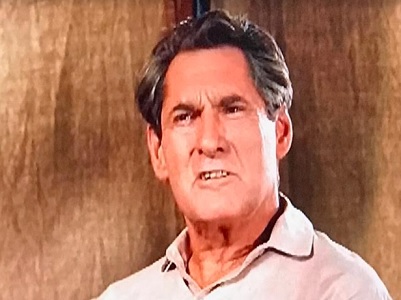
Santa Anna played by Abel Franco

From Wikipedia:

Antonio de Padua María Severino López de Santa Anna y Pérez de Lebrón (21 February 1794 – 21 June 1876), often known as Santa Anna or López de Santa Anna was a Mexican criollo who fought to defend royalist New Spain and then for Mexican independence. He served as a Mexican politician and general. He greatly influenced early Mexican politics and government, and was a skilled soldier and cunning politician, who dominated Mexican history in the first half of the nineteenth century to such an extent that historians often refer to it as the "Age of Santa Anna". He was called "the Man of Destiny", who "loomed over his time like a melodramatic colossus, the uncrowned monarch." Santa Anna first opposed the movement for Mexican independence from Spain, but then fought in support of it. Though not the first caudillo (military leader) of modern Mexico, he "represents the stereotypical caudillo in Mexican history," and among the earliest. Conservative historian, intellectual, and politician Lucas Alamán wrote that "The history of Mexico since 1822 might accurately be called the history of Santa Anna's revolutions.... His name plays the major role in all the political events of the country and its destiny has become intertwined with his."

An enigmatic, patriotic and controversial figure, Santa Anna had great power in Mexico; during a turbulent 40-year career, he served as general at crucial points and served eleven non-consecutive presidential terms over a period of 22 years. A wealthy landowner, he built a firm political base in the major port city of Veracruz. He was perceived as a hero by his troops; he sought glory for himself and his army, and independent Mexico. He repeatedly rebuilt his reputation after major losses. Historians and many Mexicans also rank him as perhaps the principal inhabitant even today of Mexico's pantheon of "those who failed the nation." His centralist rhetoric and military failures resulted in Mexico losing just over half its territory, beginning with the Texas Revolution of 1836, and culminating with the Mexican Cession of 1848 following its defeat by the United States in the Mexican–American War.

His political positions changed frequently in his lifetime; "his opportunistic politics made him a Liberal, Conservative, and uncrowned king." He was overthrown for the final time by the liberal Revolution of Ayutla in 1854 and lived most of his later years in exile.

Even though none of these other characters were Toobworld regulars*, I still think this portrayal of Santa Anna should be considered the Mexican general for the main Toobworld, as seen from the perspective of young Joel Robison. 

But this televersion of Santa Anna is not the only one to be found in Earth Prime-Time.....


"The Adventures of Jim Bowie"
    - Mexican Adventure (1957) 
Played by Rodolfo Hoyos Jr. 

In this case, Santa Anna's appearance is skewed through the perspective of Jim Bowie (the official historical televersion for the main Toobworld.)  This picture may not be of Santa Anna, however.  Rodolfo Hoyos Jr. played another character on the show in another episode.


"Texas Rising"
    - The Rise of the Republic (2015)
    - Vengeance Is Mine (2015)
    - Blood for Blood (2015)
    - Fate and Fury (2015)
    - From the Ashes (2015) 
Played by Olivier Martinez

At five episodes, this "mini-series" lasted longer than some regular series.  So I'm going to say that all of the historical televersions seen in this exploration of the founding of the Texas Rangers were official portrayals.  Any deviation from other appearances can chalked up to various points of view.

There are two off-beat portrayals of Santa Anna that only belong in Earth Prime-Time on technicalities......


"Drunk History"
    - Wild West (2013) 
Played by Horatio Sanz

The only thing that belongs in the main Toobworld would be the drunken comedians telling their stories.  The actual stories are just the depictions of their alcohol-influenced narratives.

"You Are There"
    - The Defense of the Alamo (1953) 
Played by Manuel Sebastian

In the early days of my televisiological research, I tried to incorporate this program into Earth Prime-Time, mostly because I found it to be a great boon in enhancing my interest in History.  But the idea of the televersion of CBS having access to a time machine leads to so many questions, chief among them: If they can go back in Time to key moments of History, why don't they attempt to change things that happened?

So I think 'You Are There' should be considered similar to game shows, talk shows, and variety programs in that they are basically the same in Toobworld as they are in the Real World.  In this case, the CBS televersion is also staging historical reenactments and using their pool of reporters to improvise interviews with the historical portrayals involved.

That takes care of Santa Anna in the main Toobworld.  Let's travel the multi-dimensions of the TV Universe to find others......

SKITLANDIA


"The Red Skelton Hour"
    - Deadeye and the Alamo (1961) 
Played by Cesar Romero 

I'm actually a bit surprised that this could be the only reenactment of the battle in the dimension of TV comedy sketches.  But even after all these years, perhaps the writers don't want to "go there" with American heroes who died.

TIMELESS TOOBWORLD.05


"Timeless" 
    - The Alamo (2016) 

Played by Alex Fernandez 

The pilot episode of this series did take place in Earth Prime-Time - until the main characters were thrown back to the Hindenburg crash.  Once that zeppelin's history was altered, they created a whole new dimensional off-shoot from the original timeline.  (Unlike what happened with Helen Cutter of 'Primeval', they didn't wipe out the original timeline.)  With each successive time-jump in which a significant historical event is altered, they create a new timeline and end up living in that new version of the present day.  So by the time they revisited the Alamo stand-off, they were in the fifth timeline variation which they caused.

DOCU-TOOBWORLD

"Legends & Lies" 
    - Davy Crockett: Capitol Hillbilly (2015) 
Played by Chema Pineda-Fernandez 

"Mysteries at the Museum" 
    - Leopold and Loeb, U2 Spy, Chewing Gum (2012) 
Played by Bill Weeden 

Rather than keep creating alternate Docu-Toobworlds (where historical events are depicted in a subdued, realistic manner), I'm thinking there should just be the one Docu-Toobworld but which has the same rules by which Skitlandia operates - certain historical figures can be seen over and over again and usually portrayed by recastaways.

Finally we have half a dozen TV movies which we will scatter to the astral winds so that they each end up in a different TV dimension.

CINEVERSE BORDERLAND VARIATIONS

The Alamo: Thirteen Days to Glory (1987) 
Played by Raul Julia
(pictured to the left)

The Mexican-American War (2006) 
Played by Art Bonilla

Two for Texas (1998) 
Played by Marco Rodríguez 

Texas (1994)
Played by Lloyd Battista 

Houston: The Legend of Texas (1986) 
Played by Richard Yniguez

"American Playhouse" 
    - Seguin (1982) 
Played by Edward James Olmos
(pictured above in the Wikipedia excerpt) 

O'BSERVATION:
* Theories of relateeveety arguments could be made for Sgt. Tate and Sylvester being the ancestors for "Professor" Roy Hinkley of 'Gilligan's Island' and "Doc" of 'Combat!' respectively.

BCnU!


Thursday, August 24, 2017

RECASTAWAYS - HOUSTON, WE'VE GOT A PAXTON


'DEATH VALLEY DAYS'

SAM HOUSTON
portrayed by
STEPHEN CHASE

"THE GIRL WHO WALKED WITH A GIANT" (1958)


The tumultuous political career of Sam Houston is recalled after marrying a younger Margaret Lea. Serving as leader of an independent Texas plus as governor and senator after it became a state, he relied heavily on his wife's support.

"DAVY'S FRIEND" (1962)


Young Joel is disregarded by his traveling companions as they head to Texas right after the Alamo. He is sent off on a mission to get him out of way but ends up impressing everyone.
(Plot summaries from the IMDb)

From Wikipedia:
Samuel "Sam" Houston (March 2, 1793 – July 26, 1863) was an American politician and soldier, best known for his role in bringing Texas into the United States as a constituent state. His victory at the Battle of San Jacinto secured the independence of Texas from Mexico in one of the shortest decisive battles in modern history. He was also the only governor within a future Confederate state to oppose secession (which led to the outbreak of the American Civil War) and to refuse an oath of allegiance to the Confederacy, a decision that led to his removal from office by the Texas secession convention.

Houston was born at Timber Ridge Plantation in Rockbridge County, Virginia. He was of Scots-Irish descent. After moving to Tennessee, he spent time with the Cherokee Nation, into which he later was adopted as a citizen and into which he married. He performed military service during the War of 1812 and successfully participated in Tennessee politics. In 1827, Houston was elected Governor of Tennessee as a Jacksonian. In 1829, he resigned as governor and relocated to the Arkansas Territory.

In 1832, Houston was involved in an altercation with a U.S. Congressman, followed by a high-profile trial.[4] Shortly afterwards, he moved west to Coahuila y Tejas, then a Mexican state, and became a leader of the Texas Revolution.

After the war, Houston became a key figure in Texas and was elected as the first and third President of the Republic of Texas. He supported annexation by the United States[6] and he became a U.S. Senator upon achieving it in 1845, and finally a governor of the State of Texas in 1859, whereby Houston became the only person to have become the governor of two different U.S. states through popular election, as well as the only state governor to have been a foreign head of state.

As governor, he refused to swear loyalty to the Confederacy when Texas seceded from the Union in 1861 with the outbreak of the American Civil War, and he was removed from office. To avoid bloodshed, he refused an offer of a Union army to put down the Confederate rebellion. Instead, he retired to Huntsville, Texas, where he died before the end of the war.


"Texas Rising" 
5 episodes
Played by Bill Paxton

Two for Texas (1998)
Played by Tom Skerritt

True Women
(1997)
Played by John Schneider

Texas (1994)
Played by Stacy Keach

The Alamo: Thirteen Days to Glory (1987)
Played by Lorne Greene

Houston: The Legend of Texas (1986)
Played by Sam Elliott

"Voyagers!" 

    - The Trial of Phineas Bogg (1983)
Played by Bill McLaughlin

The Honorable Sam Houston (1975)
Played by Robert Stack

"Profiles in Courage" 
    - Sam Houston (1964)
Played by J.D. Cannon

"The Great Adventure" 
    - The Testing of Sam Houston (1964)
Played by Robert Culp

"Telephone Time" 
    - Sam Houston's Decision (1957)
Played by Don Taylor

"The Adventures of Jim Bowie" 
3 episodes
Played by Denver Pyle

"Frontier" 
    - The Voyage of Captain Castle (1956)
Played by Trevor Bardette

"You Are There" 
    - The Defense of the Alamo (1953)
    - The Burning of the Alamo (1953)
Played by Philip Bosco

"Pulitzer Prize Playhouse" 
    - The Raven (1950)
Played by Zachary Scott

A LOT of heavy-hitters playing Houston in that list!

As you can see, Stephen Chase was not the only actor to play Sam Houston more than once on television - Philip Bosco (also twice), Denver Pyle (three times).  But Bill Paxton leads the pack with five episodes of 'Texas Rising'.  Some would call that a mini-series, but I've seen a lot of TV series never even get that far in broadcasts before getting the hook.

So I do consider 'Texas Rising' as a TV series and I see no reason why it can't be considered a part of the main Toobworld, making all other Toobworld portrayals of the varios historical characters the televersions seen by the regulars of those other shows.  


Maybe the death of Paxton earlier this year is influencing that; that could probably have been true if I wrote it up earlier this year.  But I think enough time has passed so that I can make the call solely based on being the curator of Toobworld.

I would say quantity trumps quality, but that would be a sleight against Paxton......

BCnU!


Wednesday, August 23, 2017

WIKI TIKI WEDNESDAY - THE LAST EMPEROR OF BRAZIL


'DEATH VALLEY DAYS'
"A KINGDOM FOR A HORSE"

DOM PEDRO II
portrayed by
GILBERT ROLAND

From the IMDb:
The Emperor of Brazil is traveling by train to San Francisco. As his private train stops to take on water, he gets off to stretch his legs and the train leaves without him. Stranded alone in the countryside, he comes upon a farm run by a widow living alone with her son and daughter. They do not believe he is truly an Emperor, so they lock him up until the sheriff comes to arrest him.

From Wikipedia:
Dom Pedro II (2 December 1825 – 5 December 1891), nicknamed "the Magnanimous", was the second and lastruler of the Empire of Brazil, reigning for over 58 years. Born in Rio de Janeiro, he was the seventh child of Emperor Dom Pedro I of Brazil and Empress Dona Maria Leopoldina and thus a member of the Brazilian branch of the House of Braganza. His father's abrupt abdication and departure to Europe in 1831 left a five-year-old Pedro II as Emperor and led to a grim and lonely childhood and adolescence. Obliged to spend his time studying in preparation for rule, he knew only brief moments of happiness and encountered few friends of his age. His experiences with court intrigues and political disputes during this period greatly affected his later character; he grew into a man with a strong sense of duty and devotion toward his country and his people, yet increasingly resentful of his role as monarch.

Inheriting an Empire on the verge of disintegration, Pedro II turned Portuguese-speaking Brazil into an emerging power in the international arena. The nation grew to be distinguished from its Hispanic neighbors on account of its political stability, zealously guarded freedom of speech, respect for civil rights, vibrant economic growth and especially for its form of government: a functional, representative parliamentary monarchy. Brazil was also victorious in three international conflicts (the Platine War, the Uruguayan Warand the Paraguayan War) under his rule, as well as prevailing in several other international disputes and domestic tensions. Pedro II steadfastly pushed through the abolition of slavery despite opposition from powerful political and economic interests. A savant in his own right, the Emperor established a reputation as a vigorous sponsor of learning, culture and the sciences. He won the respect and admiration of scholars such as Charles Darwin, Victor Hugo and Friedrich Nietzsche, and was a friend to Richard Wagner, Louis Pasteur and Henry Wadsworth Longfellow, among others.

Although there was no desire for a change in the form of government among most Brazilians, the Emperor was overthrown in a sudden coup d'état that had almost no support outside a clique of military leaders who desired a form of republic headed by a dictator. Pedro II had become weary of emperorship and despaired over the monarchy's future prospects, despite its overwhelming popular support. He did not allow his ouster to be opposed and did not support any attempt to restore the monarchy. He spent the last two years of his life in exile in Europe, living alone on very little money.

The reign of Pedro II thus came to an unusual end—he was overthrown while highly regarded by the people and at the pinnacle of his popularity, and some of his accomplishments were soon brought to naught as Brazil slipped into a long period of weak governments, dictatorships, and constitutional and economic crises. The men who had exiled him soon began to see in him a model for the Brazilian republic. A few decades after his death, his reputation was restored and his remains were returned to Brazil with celebrations nationwide. Historians have regarded the Emperor in an extremely positive light and several have ranked him as the greatest Brazilian.

Gilbert Roland was probably the only portrayal of Dom Pedro II on American television.  But I want to make certain that the world in Toobworld is represented.  And as one might expect, the last Brazilian emperor was played quite a few times on Brazilian TV.  


Of those, I going to make the claim now as to who should be the official portrayal of Dom Pedro II in Earth Prime-Time......

"Bocage"
    - O Duelo (2006) 

Played by André Gomes (as Prince D. João)

Gomes played Dom Pedro II in that show for eight episodes.  ('Bocage' was a biographical look at the life of the Brazilian poet.)  Quantity has as much to do with qualifications for consideration as does quality, so Gomes gets the nod for being the last Emperor of Brazil in Toobworld.

But there is another reason I can't consider Roland's portrayal at all.  This was from the IMDb:

Dom Pedro, Emperor of Brazil, speaks Spanish and English with a Mexican accent to the young American children. Brazilians speak Portuguese, not Spanish.

So Gilbert Roland's portrayal of Dom Pedro II will be relegated to another TV dimension.

BCnU!

Tuesday, August 22, 2017

DEATH VALLEY DENIZENS: PAULINE CUSHMAN


‘DEATH VALLEY DAYS’
“THE WOOING OF PERILOUS PAULINE”

 
From Wikipedia:
Pauline Cushman (Born Harriet Wood) (June 10, 1833 – December 2, 1893), was an American actress and a spy for the Union Army during the American Civil War.


After a Northern performance, Cushman was paid by two local pro-Confederate men to toast Confederate President Jefferson Davis after a performance. The theatre forced her to quit, but she had other ideas. She had decided to ingratiate herself with the rebels by making the toast, while offering her services to the Union as a spy.


By fraternizing with rebel military commanders, she managed to conceal battle plans and drawings in her shoes, but was caught twice in 1864 and brought before Confederate General Braxton Bragg, tried by a military court, and sentenced to death by hanging. Though she was already ill, she acted worse off than she was. The Confederates had to postpone her execution. Cushman was spared hanging by the invasion of the area by Union troops. She was also wounded twice.

Some reports state that she returned to the South in her role as a spy, dressed in male uniform. She was awarded the rank of Brevet Major by General James A. Garfield, and made an honorary major by President Abraham Lincoln for her service to the Federal cause, and became known as "Miss Major Pauline Cushman." By the end of the war in 1865, she was touring the country giving lectures on her exploits as a spy.


Sources state that in 1879 she met Jere Fryer, and moved to Casa Grande, Arizona Territory, where they married and operated a hotel and livery stable. Jere Fryer became the sheriff of Pinal County. An adopted daughter, Emma, died, and the Fryers separated in 1890.

By 1892, she was living in poverty in El Paso, Texas. She had applied for back pension based on her first husband's military service which she received in the amount of $12 per month beginning in June 1893.  Her last few years were spent in a boarding house in San Francisco, working as a seamstress and charwoman. Disabled from the effects of rheumatism and arthritis, she developed an addiction to pain medication, and on the night of 2 December 1893 she took a suicidal overdose of morphine. She was found the next morning by her landlady.


Paula Raymond was cast as Pauline Cushman in the 1964 episode "The Wooing of Perilous Pauline" of the syndicated western television series, ‘Death Valley Days’. In the story line, set in Casa Grande, where the feisty Miss Cushman was operating a saloon, she is wooed by her future husband, Jere Fryer (Ray Danton), who makes a bet with a friend that he can convince her to marry him within a week. Fryer later becomes a sheriff; the couple separated in 1890.

The television series ‘Rawhide’ also aired an episode with Pauline Cushman as the central character.


That would be:

‘RAWHIDE’
“THE BLUE SPY”


From IMDb:
 A woman wanders into camp needing help. She is an actress who one of the men recognizes later. She worked as a Union spy during the war. Although most of the men hate her, one even more so as he was court-martialed due to her.

A lone female survivor of a stagecoach attacked by Apaches, wanders into camp needing water and rest. The men happily rush to her aid learning she is an actress who after rest recites some of her work including Romeo and Juliet with Rowdy as Romeo. When Dan Madox comes in off night duty, he recognizes her as a famous Union spy, causing dissension among the drovers. The actress, who's alone on foot, has asked to tag along with Gil's drive. But when she's identified, the predominantly Texan cowboys split between bitter Confederates who don't want her sharing their water as they plod through a drought, and those who are thrilled to have professional entertainment until they hit the next town. Maddox ahas a special hatred for her as he was court-martialed and imprisoned because of his relationship with her during the war. Egged on by Kirby, Maddox and several drovers leave the drive stealing the little water they have left. When the next waterhole is dry, Favor tries to bluff them but is forced to take more drastic action to save the herd and drive.

[David Stevens]


In that episode, Cushman was portrayed by Phyllis Thaxter.  The difference in her physical appearance from one episode to the next can be attributed to the audience’s point of view being supplied by one of the other characters.  In this case, I don’t think it’s any of the regulars – Rowdy Yates, Gil Favor, or Wishbone – but instead we’re seeing Cushman through the eyes of Dan Maddox, the drover who felt that she betrayed him and caused him to be court-martialed.  (As for the televersion played by Paula Raymond, she was definitely seen through the eyes of the man who loved her, Jere Fryer.

For more on Pauline Cushman, click here.

Happy trails to you!


Monday, August 21, 2017

THE WIDOW FRIETCHIE - ZONK IF YOU MUST.....


'DEATH VALLEY DAYS'
"RENO"

BARBARA FRITCHIE
portrayed by
FLORENCE AUER

From Wikipedia:
Barbara Fritchie (née Hauer) (December 3, 1766 – December 18, 1862), also known as Barbara Frietchie, and sometimes spelled Frietschie, was a Unionist during the Civil War. She was born in Lancaster, Pennsylvania, and married John Casper Fritchie, a glove maker, on May 6, 1806. She became famous as the heroine of the 1863 poem "Barbara Frietchie" by John Greenleaf Whittier, in which she pleads with an occupying Confederate general to "Shoot if you must this old gray head, but spare your country's flag."

The flag incident as described in the poem likely never occurred at the Barbara Fritchie house, although Barbara Fritchie was a Unionist and did have a Union flag. Friends of Barbara Fritchie stated that she shook a Union flag at and insulted Confederate troops, but other neighbors said Barbara Fritchie, over 90 years old, was ill at the time.

The woman who inspired the poem was likely Mary Quantrell who lived on Patrick Street. In addition to confusing Barbara Fritchie with Mary Quantrall, the poem was likely embellished by a distant poet working from second or third hand accounts of the incident and other flag incidents. The Confederate general in the poem most likely was not (Stonewall) Jackson, but another Confederate officer since none of the men with General Jackson that day remembered the incident. Gen. Jackson and Barbara Fritchie both died before publication of the poem. Historians and reporters noted other discrepancies between the patriotic poem and witness accounts. 

Well, it looks like this is a discrepancy between the real world and Toobworld.  I mean, who are you going to believe - Frietchie's neighbors and Stonewall Jackson's officers?  Or 'Death Valley Days'?

In this episode, the Widow Frietchie is presented with the flag by Lt. Jesse Reno, who would have the Nevada town named after him in tribute to his service in the Civil War (during which he was killed in action.)  Reno was played by the hardest-working man in television, William Schallert.*

As the identity of the woman from Whittier's poem is in dispute, but positively identified in the episode, we're going to stick with Barbara Frietchie.  It certainly doesn't cause any Zonkish repercussions in the TV Universe.

And as Florence Auer and William Schallert appear to be the only actors to assay the roles of Mrs. Frietchie and Lt. Reno (respectively), then I think this episode may remain in the main Toobworld.

BCnU!

* That's not just me saying so.  That was a declaration made by TV Land, back when it was an archive for our television heritage.

Saturday, August 19, 2017

VIDEO WEEKEND: WHAT BROUGHT THE DUEL TO AN END IN AMERICA


'DEATH VALLEY DAYS'
"A GUN IS NOT A GENTLEMAN"

Yesterday I profiled Senator David Broderick.  This episode of 'Death Valley Days' confirms his existence in the main Toobworld


Happy trails to you!


Friday, August 18, 2017

AS SEEN ON TV: THE OZFATHER


Charlie: 
You were much nicer in the books.
Dorothy:
Those books are the ravings of a sad, old man.
My father.
Charlie: 
Wait. Your dad was L. Frank Baum, the writer?
Dorothy:
A Man of Letters. 
Another glorified librarian, you ask me.
'SUPERNATURAL'

From Wikipedia:
Lyman Frank Baum (May 15, 1856 – May 6, 1919), better known as L. Frank Baum, was an American author chiefly famous for his children's books, particularly "The Wonderful Wizard of Oz" and its sequels. He wrote a total of 14 novels in the Oz series, plus 41 other novels, 83 short stories, over 200 poems, and at least 42 scripts. He made numerous attempts to bring his works to the stage and the nascent medium of film; the 1939 adaptation of the first Oz book would become a landmark of 20th century cinema. His works anticipated such century-later commonplaces as television, augmented reality, laptop computers ("The Master Key"), wireless telephones ("Tik-Tok of Oz"), women in high-risk and action-heavy occupations (Mary Louise in the Country), and the ubiquity of advertising on clothing ("Aunt Jane's Nieces at Work").

In July 1888, Baum and his wife moved to Aberdeen, Dakota Territory, where he opened a store called "Baum's Bazaar". His habit of giving out wares on credit led to the eventual bankrupting of the store, so Baum turned to editing the local newspaper The Aberdeen Saturday Pioneer where he wrote the column Our Landlady. Following the death of Sitting Bull at the hands of Indian agency police, Baum urged the wholesale extermination of all America's native peoples in a column that he wrote on December 20, 1890. On January 3, 1891 he returned to the subject in an editorial response to the Wounded Knee Massacre:

"The Pioneer has before declared that our only safety depends upon the total extirmination [sic] of the Indians. Having wronged them for centuries, we had better, in order to protect our civilization, follow it up by one more wrong and wipe these untamed and untamable creatures from the face of the earth."

A recent analysis of these editorials has challenged their literal interpretation, suggesting that the actual intent of Baum was to generate sympathy for the Indians via obnoxious argument, ostensibly promoting the contrary position.


Baum's description of Kansas in "The Wonderful Wizard of Oz" is based on his experiences in drought-ridden South Dakota. During much of this time, Matilda Joslyn Gage was living in the Baum household. While Baum was in South Dakota, he sang in a quartet which included James Kyle, who became one of the first Populist (People's Party) Senators in the U.S.


  • Conlan Carter portrayed Baum in "The Wizard of Aberdeen" (1970) episode of the syndicated television series 'Death Valley Days'.
  • John Ritter portrayed Baum in the television movie "Dreamer of Oz" (1990).

Neither one of these contradicts the other.  Conlan Carter played the role first so he is the official televersion for the author.  But John Ritter's televersion is valid - however, he is the embodiment of Maud Baum's memories in her old age (triggered by her attendance at the premiere of "The Wizard Of Oz" movie in 1939.) 


The discrepancy in the life of L. Frank Baum in Toobworld occurs in a TV show episode in which he didn't even appear.....


From the Supernatural Wiki:
L. Frank Baum was a member of the Men of Letters, as well as the writer of The Wonderful World of Oz and its subsequent sequels. At some point, after Clive Dillon became trapped in Oz, Baum found the Key to Oz and traveled there to rescue Clive. He unknowingly brought along his daughter Dorothy who became trapped in Oz. After Dorothy returned to Earth, Baum wrote the Wizard of Oz books as clues to Dorothy about how to fight the Wicked Witch of the West.

While in 'Supernatural' the character of Dorothy was written as his daughter, in real life Baum had four sons and no daughters.

"Don't you get it? 
The books aren't silly. They're guidebooks filled with clues he left for you. 
Haggerty poured through each one, and his research led him to uncover the poppies.  So maybe there's something else from the books we can use.
Preferably something with a pointy end....."

We got some splainin to do!

And to do so, we have to turn to yet another TV show.....


From The Librarians Wiki:
Fictionals are a race of magical beings summoned from stories encountered in the second season of the Librarians.

According to Jenkins there are two main types of Fictionals; those that can be summoned by powerful magic and those that come into being of their own accord. The second type are iconic characters whose stories are both well written and well known.

Though rare in the modern day Jenkins's believed there was most likely a small group of Fictionals living in the modern world; their magical existence sustained by the fame and acclaim of their stories. Also, and thankfully most of them don't cause to much trouble; the Library has also struggled to keep track of them. Flynn commented he had always heard about them but had never actually met one

Generally Fictionals do not adapt well to the world outside their stories; Jenkins explained that their minds are only as complex has what their creator wrote meaning they may not be able to understand little if anything outside their stories. Fictionals from older or well written stories tend to have a better time adapting.

Fictionals are bound by their stories, but also empowered by them.

Though sentient beings Fictionals are bound to the narrative of their stories meaning they can be trapped and defeated in the ways their stories dictate. For example Moriarty did not die when Eve stabbed him, because that was not the way his story said he would die. Despite this Prospero found a way to partially break with the narrative of his story such has when he managed to retrieve his spell book through magic. Fictionals can become extremely powerful if real life events matches their narrative. For example Prospero used the white king, pearl earrings, a storm,etc to break the magical seal on the box containing his spell book. Outside of defeating them in the way their story dictates a Ficitonal can be destroyed if the specific book they appeared from is destroyed.

It appears that certain fictionals have their own opinions of their creators with Prospero loathing Shakespeare for the ending of his story and "abandoning" him when the Bard passed away.


The televersion of L. Frank Baum so believed in his character of Dorothy that it brought her to life in Toobworld.  And as such, she perceived the author as her "father".  That means that Dorothy herself was something from the books which could be used to fight their enemies. 

BCnU!

O'BSERVATION: This post is the 10,800th entry for Inner Toob!


Thursday, August 17, 2017

AS SEEN ON TV: SENATOR DAVID BRODERICK


It could be due to Carroll O'Connor's performance in an episode of 'Death Valley Days' as to why I find Senator Broderick such a fascinating character.  Broderick could have slipped totally into obscurity had it not been that his death may have spurred a change in a spurious tradition in the United States.

From Wikipedia:
David Colbreth Broderick (February 4, 1820 – September 16, 1859) was an attorney and politician, elected by the legislature as Democratic U.S. Senator from California. Born in Washington, DC, to Irish immigrant parents, he lived in New York until moving to California during the Gold Rush. He was a first cousin of politicians Andrew Kennedy of California and Case Broderick of Kansas.

Broderick was born in 1820 in Washington, D.C., on East Capitol Street just west of 3rd Street. He was the son of an Irish stonecutter and his wife. His father had come to the United States in order to work on the United States Capitol. In 1823 Broderick moved with his parents to New York City. There he attended public schools and was apprenticed to a stonecutter.


In 1849, Broderick joined the California Gold Rush. He moved to San Francisco, where he engaged in smelting and assaying gold. Broderick minted gold coins that contained less gold than their face value, keeping the difference. His $10 coins, for example, contained $8 in gold. He used the profits to finance his political aspirations.

Broderick was a member of the California State Senate from 1850 to 1852, serving as its president from 1851 to 1852. Broderick was acting Lieutenant Governor from January 9, 1851 to January 8, 1852, following incumbent John McDougall's succession to the governorship. From then on, Broderick effectively had political control of San Francisco, which under his "utterly vicious" rule soon became notorious for municipal corruption.[3] In the words of his biographer Jeremiah Lynch:

In San Francisco he became the dictator of the municipality. His political lessons and observations in New York were priceless. He introduced a modification of the same organization in San Francisco with which Tammany has controlled New York for lo! these many years. It was briefly this. At a forthcoming election a number of offices were to be filled; those of sheriff, district attorney, alderman, and places in the legislature. Several of these positions were very lucrative, notably that of the sheriff, tax-collector, and assessor. The incumbents received no specified salaries, but were entitled to all or a certain proportion of the fees. These fees occasionally exceeded $50,000 per annum. Broderick would say to the most popular or the most desirable aspirant: 'This office is worth $50,000 a year. Keep half and give me the other half, which I require to keep up our organization in the state. Without intelligent, systematic discipline, neither you nor I can win, and our opponents will conquer, unless I have money enough to pay the men whom I may find necessary. If you agree to that arrangement, I will have you nominated when the convention assembles, and then we will all pull together until after the election.’ Possibly this candidate dissented, but then someone else consented, and as the town was hugely Democratic, his selections were usually victorious.

Broderick became rich from this system.


In 1856 Broderick was elected by the state legislature for a seat as US Senator from California. (Popular election of senators did not start until the 20th century.) Broderick began his term on March 4, 1857.

At that time, just prior to the start of the American Civil War, the Democratic Party of California was divided between pro-slavery and "Free Soil" factions. Broderick led the Free Soilers. One of his closest friends was David S. Terry, formerly the Chief Justice of the California State Supreme Court. He advocated extending slavery into California. Terry lost his re-election bid because of his pro-slavery platform, and he blamed Broderick for the loss.

Terry, considered even by his friends as caustic and aggressive,[6] made some inflammatory remarks at a party convention in Sacramento, which Broderick read. He took offense, and sent Terry an equally vitriolic reply, describing:

'Terry to be a "damned miserable wretch" who was as corrupt as President James Buchanan and William Gwin, California's other senator. "I have hitherto spoken of him as an honest man--as the only honest man on the bench of a miserable, corrupt Supreme Court--but now I find I was mistaken. I take it all back. He is just as bad as the others."'

Passions escalated; on September 13, 1859, former friends Terry and Broderick, both expert marksmen, met outside of San Francisco city limits at Lake Merced for a duel. The pistols chosen for the duel had hair triggers, and Broderick's discharged prior to the final "1-2-3" count, firing prematurely into the ground. Thus disarmed, he was forced to stand as Terry shot him in the right lung. Terry at first believed the shot to be only a flesh wound, but it proved to be fatal. Broderick died three days later, and was buried under a monument erected by the state in Lone Mountain Cemetery in San Francisco. In 1942 he was reinterred at Cypress Lawn Memorial Park in Colma.


BCnU!