Sunday, November 2, 2008

#3200: A DOUBLE LIFE ON MARS

"Perhaps he is operating in an alternate reality...."
TV Scientist
'Life On Mars' (US)

Okay, it's finally time to render my decision about the American version of 'Life On Mars', now that I've caught up on the last two episodes (due to my trip to Colorado and this week's all-night bit torrent party down in the Village).
Just as it happened in the UK version of 'Life On Mars', NYPD detective Sam Tyler was struck down by a car and found himself back in 1973 at his same precinct.

Even though TV series remakes usually must be relegated to the alternate TV dimension for such series, it's the opinion of Toobworld Central that both versions of the show - the UK original with John Simm and Philip Glenister and the ABC freshman series which stars Jason O'Meara and Harvey Keitel - can remain in Earth Prime-Time. And we have the sequel to the original series to thank for that.

In 'Ashes To Ashes', police psychologist/profiler DCI Alex Drake read the full report of Sam Tyler's account of his life in 1973 Manchester which turned out to be a coma dream. When she found herself in a similar situation due to a bullet to the head, Alex drew upon that report to recreate Sam's "artificial constructs" of Ray, Chris, and the Gene Genie himself.
It's going to be the conceit of Toobworld Central that somebody else in Scotland Yard got hold of that account by Sam Tyler; somebody who knew a Manhattan police detective by the same name. Thinking his American friend might get a kick out of it, he (or she) downloaded almost the entire file and emailed it to the Sam Tyler of the NYPD. (He probably figured it was an amazing coincidence that the Sam he knew in America also had a girl-friend of color named Maya.)

I say "almost the entire file" because an important segment of it must have been left behind - sketches by DCI Sam Tyler which illustrated his mind's experiences.

Although we never saw him draw anything, only record his impressions to be later transcribed, at some point Sam must have had the police sketch artist draw up detailed renderings of what Gene Hunt and the others looked like in his dream-state. How else to explain that Alex Drake saw them exactly the same way? (A purer TV experience would have had other actors now playing the roles, fitting her personal vision of what the characters looked like.)

But Sam didn't get those details supplied by the sketches. So when he found himself in his own version of that coma-world at the 125th Precinct of 1973, his mind had to create his own versions of Gene, Ray, Annie, and Chris. In fact, in the case of Annie, his mind even gave her a new last name; changed from Cartwright to Norris. (Perhaps deep down the sub-conscious of Manhattan Sam realized that Manchester Sam had a special relationship with Annie Cartwright and didn't want to intrude on it.)

(The Manhattan Sam probably didn't have access to the tapes made by the Manchester Sam, either. If he had, his dream-version of Gene Hunt would have done a better job with my favorite line from the entire series - "You're surrounded by armed bastards." As delivered by Glenister, it was so full of bluster that I awarded it the Toobit for best catch-phrase. Keitel tossed it off as a throw-away; tired, resigned, and then the network cut right to the commercial, perhaps knowing the line was a wasted effort.)

Of course, this is all theory, but since it would have happened before the American version premiered, we don't have to really worry about it ever being contradicted.
Although most of the details of his new "life" are drawn from the account written up by the other Sam Tyler, the same report read by DCI Alex Drake in 'Ashes To Ashes', other details come from Sam's personal experiences.

One of these would be the name given to Nick Profaci.

As played by Lenny Venito, Profaci was a thug working for Casso in the 1973 world. But Sam dredged up a name for him from his past association with Detective Tony Profaci who worked down at the 2-7 until he was indicted for murder. (The character, played by John Fiore, made about fifty appearances on 'Law & Order' and was finally arrested in the TV movie "Exiled".)
The American Sam Tyler is rehashing most of the case details as experienced by the British Sam, but filtered through the fact that he just can't relate to certain aspects of British life. So instead of investigating the death of a soccer fan due to hooliganism, he's found himself back in 1973 looking into the death of a Vietnam Vet who was a closeted gay man. But the other details of the original case - like his bonding with the victim's son and even bumping into his younger self as his father took Sam-as-boy to a sporting event - remained the same.

The last nub to this premise is that there had been an earlier pilot episode filmed by David E. Kelley and distributed on the Internet. In this version, Sam Tyler - still played by O'Meara - was a cop in Los Angeles; his dream-world partners included Colm Meaney as Gene Hunt. Meaney's slight resemblance to Glenister would make me think that he did have access to the alleged sketches. However, there was no Ray Carling, but instead an older, comic-relief cop (as played by Lenny Clarke).

Even though this pilot was created before the one that eventually aired, the number of episodes already broadcast give the second version of 'Life On Mars' preeminence in Toobworld. So this would be one of those cases, like "The Strange World Of Horace Ford", where the original version is the one exiled, not the remake.

And so it goes.

BCnU!
Toby O'B

TRAILER PERK

I have no qualms against product placement, so long as it's done with wit, style, and it plays under the radar for the most part. The biggest transgressor this season has been the (ab)use of Degree anti-perspirant in 'Eureka'. Its first appearance was cute, as it seemed to acknowledge that product placement was fast becoming "in yo' face" in TV shows. But then week after week, its intrusion became more noticeable, to the point that it finally became an actual plot point, the deus ex machina that saved the day in fact!

But recently there were two examples, both for upcoming movies, whose placement was much more subtle and therefore more effective, since they didn't turn away the potential audience.

On 'Entourage', the trailer for "Max Payne" was playing in the background on the monitor in Ari Gold's office. This also served as an in-joke since "Max Payne" stars Mark Wahlberg, who is the executive producer of 'Entourage'.

The other example was also an in-joke and perhaps even more subtle in its placement. On 'Mad Men' executive secretary Joan Holloway was at home with her fiance Greg and they were watching "The Day The Earth Stood Still". A new version of that sci-fi classic will be out soon, starring Keanu Reeves... and co-starring Jon Hamm, who plays the lead role in 'Mad Men', Don Draper.

Klaatu Nikto BCnU!
Toby O'B

Saturday, November 1, 2008

TODAY'S TWD: THE PEACE CORPS

November 1, 1960 - While campaigning for President of the United States, John F. Kennedy announces his idea of the Peace Corps.

Here's the scoop from Wikipedia:

The Peace Corps is an independent United States federal agency. The Peace Corps was established by Executive Order 10924 on March 1, 1961, and authorized by Congress on September 22, 1961, with passage of the Peace Corps Act (Public Law 87-293). The Peace Corps Act declares the purpose of the Peace Corps to be:

“to promote world peace and friendship through a Peace Corps, which shall make available to interested countries and areas men and women of the United States qualified for service abroad and willing to serve, under conditions of hardship if necessary, to help the peoples of such countries and areas in meeting their needs for trained manpower.”

Since 1960, more than 190,000 people have served as Peace Corps volunteers in 139 countries.

There have been a few in Toobworld as well, not that all of them made it.......
As Thanksgiving approached in 1963, Elizabeth Walton of Walton's Mountain, Virginia, was inspired by President John F. Kennedy to join the Peace Corps. ("The Waltons: Thanksgiving Reunion")

The following year, Patty Lane also considered joining the Peace Corps. She lied about her age on the application and was accepted to work in Africa. ('The Patty Duke Show')

After marrying Dr. Bruce Gaines in 1986, Edna Garrett turned over the management of her shop Peekskill gourmet shop to her sister so that she could go to Africa to work with the Peace Corps. ('The Facts of Life')

In the early 1990s, Harrison Mills met his future wife Celia, a former Olympic cyclist, while they were both working in the Peace Corps. ('Beverly Hills 90210' - new version)

In the late 1990s, an idealistic hippie named Barney Stinson was planning to go to Nigeria to work for the Peace Corps with his girl-friend Shannon. But when she dumped him on the eve of their journey, the experience transformed him into the heartless, soul-less, but very funny womanizer he is today. ('How I Met Your Mother')

Anybody know of any other Peace Corps volunteers in Toobworld?

BCnU!
Toby O'B

BEAM ME UP TO BEANTOWN

"I watched 'Boston Legal' nine times
before I realized it wasn't a new 'Star Trek
.'"
Tracy Jordan
'30 Rock'
I watched my DVR-tifact of the season premiere of '30 Rock' today, and quite frankly? I don't even remember that line.

I'm getting old.

At any rate, we can always count on '30 Rock' to Zonk the hell out of the TV Universe. What can you expect from a TV show about TV shows?

For us viewing at home in the Trueniverse, it's obvious what this Zonk implied - Tracy couldn't tell the difference between both shows because William Shatner starred in both. (I guess I have to get used to talking about 'Boston Legal' in the past tense.)

But the writers of '30 Rock' are not only brilliant, they also respect their audience. Some sitcom scribblin' hack might have overburdened that joke with splainins as to why Tracy made that mistake. The '30 Rock' writers know that we'll get it.

And that makes it easier to de-Zonk it!

Although we know the common factor between 'Boston Legal' and 'Star Trek' is Shatner, he was never mentioned; so we don't have to worry about getting around the fact that he plays Denny Crane on the former and James T. Kirk on the latter. As for the shows themselves, we've dealt with 'Star Trek' in the past. It has been mentioned and lampooned so often in the past on other TV shows (Halloween costumes, dream sequences, etc.), that it's almost tempting to just throw up my chubby meat-sticks in defeat. However, Toobworld Central has an all-encompassing splainin - somebody from the future, with knowledge of the "real" Starfleet came back to the 1960s and gave the televersion of Gene Roddenberry all of the information necessary for him to recreate the actual future of Earth Prime-Time, including such details as what the future participants looked like so that he could cast accordingly.

As for 'Boston Legal', we're lucky enough in that David E. Kelley gave it such a generic title. The joke had no mention of Denny Crane, or Alan Shore or of Crane, Poole, and Schmidt. So it could have been about anything that dealt with the legal profession in Beantown, even a reality show. And within the context of Toobworld, that just shows how off-kilter Tracy Jordan is that he couldn't tell the difference.

So as far as that Zonk goes, we can set our phasers on the highest setting and exterminate! Exterminate! Exterminate!

Okay, so I'm mixing my sci-fi shows. Go up to Boston and sue me.

BCnU!
Toby O'B

Friday, October 31, 2008

TODAY'S TWD: THE GREAT HOUDINI

October 31, 1926:
Harry Houdini, Hungarian-born magician, died. (b. 1874)

Here's an excerpt of his biography from Wikipedia:

Harry Houdini (March 24, 1874 – October 31, 1926) whose birth name in Hungary was Erik Weisz (which was changed to Ehrich Weiss when he immigrated to the United States), was a Jewish Hungarian American magician, escapologist (widely regarded as one of the greatest ever) and stunt performer, as well as a skeptic and investigator of spiritualists, film producer and actor. Harry Houdini forever changed the world of magic and escapes.

Initially, Houdini's magic career resulted in little success. He performed in dime museums and sideshows, and even doubled as "the Wild Man" at a circus. Houdini initially focused on traditional card tricks. At one point, he billed himself as the "King of Cards". But he soon began experimenting with escape acts. In 1893, while performing with his brother "Dash" at Coney Island as "The Brothers Houdini", Harry met and married fellow performer Wilhelmina Beatrice (Bess) Rahner. Bess replaced Dash in the act, which became known as "The Houdinis". For the rest of Houdini's performing career, Bess would work as his stage assistant.
Harry Houdini's "big break" came in 1899 when he met manager Martin Beck in rural Woodstock, Illinois. Impressed by Houdini's handcuffs act, Beck advised him to concentrate on escape acts and booked him on the Orpheum vaudeville circuit. Within months, he was performing at the top vaudeville houses in the country. In 1900, Beck arranged for Houdini to tour Europe.

Houdini was a sensation in Europe, where he became widely known as "The Handcuff King". He toured England, Scotland, the Netherlands, Germany, France, and Russia. In each city, Houdini would challenge local police to restrain him with shackles and lock him in their jails. In many of these challenge escapes, Houdini would first be stripped nude and searched. In Moscow, Houdini escaped from a Siberian prison transport van. Houdini publicly stated that, had he been unable to free himself, he would have had to travel to Siberia, where the only key was kept. In Cologne, he sued a police officer, Werner Graff, who claimed he made his escapes via bribery. Houdini won the case when he opened the judge's safe (he would later say the judge had forgotten to lock it).
With his new-found wealth and success, Houdini purchased a dress said to have been made for Queen Victoria. He then arranged a grand reception where he presented his mother in the dress to all their relatives. Houdini said it was the happiest day of his life. In 1904, Houdini returned to the U.S. and purchased a house for $25,000, a brownstone at 278 W. 113th Street in Harlem, New York. The house still stands today.

From 1907 and throughout the 1910s, Houdini performed with great success in the United States. He would free himself from jails, handcuffs, chains, ropes, and straitjackets, often while hanging from a rope in plain sight of street audiences. Because of imitators and a dwindling audience, on January 25, 1908, Houdini put his "handcuff act" behind him and began escaping from a locked, water-filled milk can. The possibility of failure and death thrilled his audiences. Houdini also expanded his challenge escape act - in which he invited the public to devise contraptions to hold him - to include nailed packing crates (sometimes lowered into the water), riveted boilers, wet-sheets, mailbags, and even the belly of a whale that washed ashore in Boston. At one point, brewers challenged Houdini to escape from his milk can after they filled it with beer. Many of these challenges were prearranged with local merchants in what is certainly one of the first uses of mass tie-in marketing.

Rather than promote the idea that he was assisted by spirits, as did the Davenport Brothers and others, Houdini's advertisements showed him making his escapes via dematerializing, although Houdini himself never claimed to have supernatural powers.

In 1912, Houdini introduced perhaps his most famous act, the Chinese Water Torture Cell, in which he was suspended upside-down in a locked glass-and-steel cabinet full to overflowing with water. The act required that Houdini hold his breath for more than three minutes. Houdini performed the escape for the rest of his career. Despite two Hollywood movies depicting Houdini dying in the Torture Cell, the escape had nothing to do with his demise.

In the 1920s, after the death of his beloved mother, Cecilia, he turned his energies toward debunking self-proclaimed psychics and mediums, a pursuit that would inspire and be followed by later-day conjurers Milbourne Christopher, James Randi, Martin Gardner, P.C. Sorcar, Dorothy Dietrich, Criss Angel, Derren Brown and Penn and Teller. Houdini's training in magic allowed him to expose frauds who had successfully fooled many scientists and academics. He was a member of a Scientific American committee that offered a cash prize to any medium who could successfully demonstrate supernatural abilities. Thanks to the contributions and skepticism of Houdini and four other committee members, the prize was never collected. The first to be tested was medium George Valentine of Wilkes Barre, Pennsylvania. As his fame as a "ghostbuster" grew, Houdini took to attending séances in disguise, accompanied by a reporter and police officer. Possibly the most famous medium whom he debunked was the Boston medium Mina Crandon, also known as "Margery". Houdini chronicled his debunking exploits in his book, "A Magician Among the Spirits".

These activities cost Houdini the friendship of Sir Arthur Conan Doyle, the creator of Sherlock Holmes. Conan Doyle, a firm believer in Spiritualism during his later years, refused to believe any of Houdini's exposés. Conan Doyle actually came to believe that Houdini was a powerful spiritualist medium, had performed many of his stunts by means of paranormal abilities and was using these abilities to block those of other mediums that he was 'debunking' (see Conan Doyle's "The Edge of The Unknown", published in 1931, after Houdini's death). This disagreement led to the two men becoming public antagonists. Gabriel Brownstein has written a fictionalized account of the meetings of Houdini, Conan Doyle, and "Margery" in "The Man from Beyond: A Novel" (2005).

Harry Houdini died of peritonitis secondary to a ruptured appendix. It has been speculated that Houdini was killed by a McGill University student, J. Gordon Whitehead, in Montreal. Houdini died of a ruptured appendix, caused by Whitehead delivering multiple blows to Houdini's abdomen.

Although in serious pain, Houdini nonetheless continued to travel without seeking medical attention. Harry had apparently been suffering from appendicitis for several days and refusing medical treatment. His appendix would likely have burst on its own without the trauma.

When Houdini arrived at the Garrick Theater in Detroit, Michigan, on October 24, 1926, for what would be his last performance, he had a fever of 104 degrees F (40°C). Despite a diagnosis of acute appendicitis, Houdini took the stage. He was reported to have passed out during the show, but was revived and continued. Afterwards, he was hospitalized at Detroit's Grace Hospital. Houdini died of peritonitis from a ruptured appendix at 1:26 p.m. in Room 401 on October 31 (Halloween), 1926, at the age of 52.

Harry Houdini was portrayed in Toobworld several times, mostly in TV movies, but in episodes of 'Voyagers!' and 'Mentors' as well.

1976 - Houdini was played by Paul Michael Glaser, of 'Starsky and Hutch' fame, in a 1976 TV movie called "The Great Houdinis" (aka "The Great Houdini"), which was also highly fictionalized. The film focused on Houdini's relationship with his wife and mother, who were portrayed as frequently bickering (although, in reality, they had cordial relations) and on his fascination with life after death. The cast also included Sally Struthers, Bill Bixby, Vivian Vance, and Ruth Gordon.

1985 - Wil Wheaton played Houdini in "Young Harry Houdini", a made-for-TV movie that aired on ABC as a "Disney Sunday Movie." The film also featured Jeffrey DeMunn as the adult Houdini. DeMunn first played Houdini in the film version of "Ragtime".

1998 - Johnathon Schaech played Houdini in the TNT original movie "Houdini". The film co-starred Stacy Edwards as Bess and Mark Ruffalo as his brother, Dash (aka Theo. Hardeen). The TV movie first aired on December 6, 1998.

[Plot descriptions from Wikipedia]

Thanks to the leeway given to recastaways due to the aging of characters, I think "The Great Houdinis" (by virtue of being the first presentation of Houdini's life, even if it was greatly fictionalized) and "Young Harry Houdini" can both be placed in Earth Prime-Time, the main Toobworld.

As for his portrayal by Michael Durrell in the 'Voyagers!' episode "Agents of Satan", it's been the Toobworld Central contention that the main characters of the show are part of Earth Prime-Time, but that they are always meddling in alternate timelines so that they follow the follow chronological flow of Earth Prime-Time. So the Houdini that they met was of an alternate dimension.
BCnU!
Toby O'B

Thursday, October 30, 2008

NANANANANANANANA - DEBATEMAN!

Thanks to Win Scott Eckert of The Wold Newton Universe site (link to the left, True Believers!), I found out where Senator John McCain's campaign found the tactics they've been using against Senator Barack Obama:


Sarah Palin could be a new character - Moosewoman.

Villain or heroine, that's for you to decide.

BCnU!
Toby O'B

TODAY'S TWD: THE WAR OF THE WORLDS

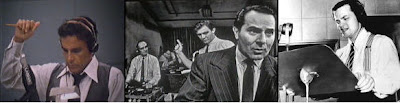
October 30, 1938 - Orson Welles broadcasts his radio play of H. G. Wells's "The War of the Worlds", causing anxiety in some of the audience in the United States.

Vera:
"Anybody know it was a prank?"
Stillman:
"The power of radio in those days, Nick.
It was the only live news source."
Lilly:
"Back when the news wasn't about the latest starlet's drunk driving bust."
'Cold Case'

As Lisa Swan puts it in today's New York Daily News,
"The Martians are coming! The Martians are coming! Seventy years ago [today], that was what some listeners of Orson Welles' radio dramatization of "War of the Worlds" feared was taking place. The Halloween-themed broadcast, which aired Sunday night, October 30, 1938, scared the living daylights out of millions of listeners."

From Wikipedia:

"The War of the Worlds" was an episode of the American radio drama anthology series 'Mercury Theatre on the Air'. It was performed as a Halloween episode of the series on October 30, 1938 and aired over the Columbia Broadcasting System radio network. Directed and narrated by Orson Welles, the episode was an adaptation of H. G. Wells' novel The War of the Worlds.

The first two thirds of the 60-minute broadcast was presented as a series of simulated news bulletins, which suggested to many listeners that an actual Martian invasion was in progress. Compounding the issue was the fact that the Mercury Theatre on the Air was a 'sustaining show' (i.e., it ran without commercial breaks), thus adding to the dramatic effect. Although there were sensationalist accounts in the press about a supposed panic, careful research has shown that while thousands were frightened, there is no evidence that people fled their homes or otherwise took action.

The news-bulletin format was decried as cruelly deceptive by some newspapers and public figures, leading to an outcry against the perpetrators of the broadcast, but the episode launched Welles to fame.Welles's adaptation was one of the Radio Project's first studies.

That historic broadcast was a factor in several TV productions and thus is incorporated into Toobworld. 'Studio One' presented "The Night America Trembled" which showed not only a recreation of the broadcast in the studio, but its effect on various people listening in the area. Among the actors were Warren Beatty, James Coburn, and Ed Asner. Over twenty years later, the TV movie "The Night That Panicked America" did the same thing with Vic Morrow and John Ritter as men caught up in the panic caused by the show and Paul Shenar as Welles. In 2003, "Days That Shook the World" presented "Fact or Fiction: The War of the Worlds and the Hitler Diaries".
It was also integrated into the plotlines of a few TV series. In 'The War of the Worlds', one episode took place in Grover's Mill during the 50th anniversary of the broadcast, it is revealed that Orson Welles was hired by the government to orchestrate the broadcast in order to cover up what was a reconnaissance mission by the same aliens who would launch an all-out war 15 years later. 'Touched By An Angel' featured parts of the original broadcast in a Halloween episode titled "The Sky Is Falling", where an old man had to deal with the trauma he endured during the nation wide panic, including the death of his father due to a misfire by a paranoid citizen.

The November 4, 2007 episode of 'Cold Case' dealt with a murder that took place during the panic surrounding the original 1938 radio broadcast. In the October 15, 1956 episode of 'I Love Lucy', "Lucy Meets Orson Welles", Lucy is shopping for scuba gear in Macy's at the same time Welles is signing record albums of his Shakespearian readings. After Lucy approaches him still wearing a Scuba mask, flippers and assorted air hoses, Wells takes one look at her and says, "My 'Man from Mars' broadcast was 18 years ago...where were you?"

[Those four plot descriptions were also from Wikipedia.]

For a great website about the historical perspective of "The War Of The Worlds",
click here.

"This is Orson Welles, ladies and gentlemen, out of character to assure you that 'The War of The Worlds' has no further significance than as the holiday offering it was intended to be. The Mercury Theatre's own radio version of dressing up in a sheet and jumping out of a bush and saying 'Boo!'

"We couldn't soap all your windows and steal all your garden gates by tomorrow night. . . so we did the best next thing. We annihilated the world before your very ears, and utterly destroyed the C. B. S. You will be relieved, I hope, to learn that we didn't mean it, and that both institutions are still open for business.

"[Remember] the terrible lesson you learned tonight. That grinning, glowing, globular invader of your living room is an inhabitant of the pumpkin patch, and if your doorbell rings and nobody's there, that was no Martian. ... It's Halloween."
- Orson Welles

TV Crossover Hall Of Fame inductee (televersion)
October 2001

BCnU!
Toby O'B

LEAVE IT TO LAME BEAVER

Since I went to Colorado, 'Centennial' country, I've been playing around with an online English to Arapaho dictionary - I like to figure out how "Toobworld" might translate into other languages.

Near as I can tell, it would be ce'ískuu3óó hee3éí'o'béé', literally "Television World". (ce'ískuu3óó also stands for movie, so this would work for Craig Shaw Gardner's Cineverse.)

With those 3's in there, don't ask me how to pronounce it.

Just for kicks, I came up with some names for Senators Barack Obama and John McCain.

híni' céése' - That One

beh'iihehi' - Old Man

As for me? You can call me hoohookee heesooku'oonoo (The Crazy Guy Who Is Watching)!

heetce'noohobe3en!
Toby O'B

Wednesday, October 29, 2008

PHILLY FLASH

My sense of "serendipiteevee" came into play again tonight. I turned on the World Series at 9:58 pm, just in time to see the last pitch.

My team wasn't in it, so neither was my heart. But congrats to the Phillies.

Now I can only hope that it's reflected in some future episode of 'It's Always Sunny In Philadelphia'!


BCnU!
Toby O'B

TODAY'S TWD: DON GIOVANNI

While I was in Colorado, I was privileged to watch my young friend Rachel record an EP-CD and DVD for her college admission auditions to study opera. O'Bviously I'm prejudiced, but she's very talented and I am certain she'll find her niche in that world.

So today's Tiddlywinkydink is dedicated to her.....

October 29, 1787:
Mozart's opera Don Giovanni receives its first performance in Prague.

From the burgomeisters of Wikipedia:

Don Giovanni (K.527; complete title: Il dissoluto punito, ossia il Don Giovanni, literally "The Rake Punish'd, or Don Giovanni") is an opera in two acts with music by Wolfgang Amadeus Mozart and with Italian libretto by Lorenzo da Ponte. It was premiered in the Estates Theatre in Prague on October 29, 1787. Of the many operas based on the legend of Don Juan, "Don Giovanni" is thought to be beyond comparison. Da Ponte's libretto was billed like many of its time as dramma giocoso: "giocoso" meaning comic, and "dramma" signifying an operatic text (an abbreviation of "dramma per musica"). Mozart entered the work into his catalogue as an "opera buffa". Although often classified as comic, it is a unique blend of comic (buffa) and drama (seria). Subtitled "dramma giocoso", the opera blends comedy, melodrama and supernatural elements.

The Danish philosopher Søren Kierkegaard wrote a long essay in his book Enten/Eller (Either/Or) in which he argues, quoting Charles Gounod, that Mozart's "Don Giovanni" is “a work without blemish, of uninterrupted perfection.”

The basic plot is this:

Don Giovanni, a young nobleman, after a life of amorous conquests, meets defeat in three encounters. The first is with Donna Elvira, whom he has deserted but who still follows him. The second is with Donna Anna, who must postpone her marriage to Don Ottavio after Don Giovanni tries to rape her and kills her father, the Commendatore, while escaping afterwards. The third is with Zerlina, whom he vainly tries to lure from her fiancé, the peasant Masetto. All vow vengeance on Don Giovanni and his harassed servant Leporello. Elvira alone weakens in her resolution and attempts reconciliation in the hope that Giovanni will reform. Don Giovanni's destruction and deliverance to hell are effected by the cemetery statue of the Commendatore, who had accepted the libertine's invitation to supper.

As a staple of the standard operatic repertoire, it appears as number seven on Opera America's list of the 20 most-performed operas in North America.

By my count, there have been 17 performances of "Don Giovanni" on television since 1967. Among those who have played the title role for TV are Eugene Perry and Bryn Terfel (whom even I, an opera imbecile, have heard of). Thomas Allen and Samuel Ramey have each played it twice for TV productions. Renowned stage director Peter Sellars set his TV production of "Don Giovanni" in the streets; I think Giovanni's final descent into Hell was through a sewer manhole.
"Don Giovanni feels that you can live without rules or obligations,
but that doesn't work.
Hell is (Don Giovanni) being himself. "
Nicolette Molnar
Utah Opera

BCnU!
Toby O'B